
Options for Foreign Residents in Vietnam Earning Income from Social Media ― Barriers in business registration, employment, residence and tax to understand before starting as an individual, and a comparison of three practical structures
2026/10/27
- I-GLOCAL.CO.,LTD. Hanoi Office
- CFE
- Kiriko Kashima
Executive Summary
(1) Operating as a sole proprietor is not viable: Foreigners cannot register a household business (hộ kinh doanh) in Vietnam, and as individuals they have no sponsoring entity for a work permit or residence status. In practice, it is therefore very difficult to earn ongoing income from social media as an individual.
(2) A tax mismatch: Under tax law, income is taxable regardless of business registration, and income from platforms is treated as business income. However, paying tax does not provide a legal basis for conducting business or working, leaving the individual with tax obligations only.
(3) Three practical structures: The most realistic option is to be affiliated with a foreign entity under an employment or service contract and work remotely on assignments directed outside Vietnam. Employment by a Vietnamese company under a labour contract is limited by the small number of companies willing to hire foreigners, and setting up a company involves a heavy burden in terms of capital and foreign investment restrictions.
(4) Early review and transition: Continuing to operate as an individual exposes a person to fines, tax reassessments and deportation. Those who already earn income should also review their income and contractual flows and consider moving to an appropriate structure.
Introduction
In recent years, ways of earning income individually through social media have spread, such as monetisation on YouTube, TikTok and Instagram, sponsored posts in collaboration with companies, and the operation of paid online communities. Many foreigners living in Vietnam are also interested in earning income from these activities.
However, while monetising social media may appear easy to start, the hurdles for foreigners living in Vietnam to operate in full compliance with the law are far higher than expected. In particular, foreigners cannot register as sole proprietors in Vietnam, and must consider not only business registration but also the rules on employment, residence and tax.
This article outlines the issues that arise when foreigners earn social media income in their own name, and explains three practical options for operating lawfully, together with the points to note for each.
1.What Is the Problem with Operating as an Individual?
①Business registration: foreigners cannot use the hộ kinh doanh structure
The structure in Vietnam closest to a sole proprietorship is the hộ kinh doanh (household business). However, Article 82 of Decree 168/2025/NĐ-CP provides that, in principle, a household business may be established by Vietnamese citizens with full civil act capacity. Foreigners therefore cannot register a hộ kinh doanh in their own name. Vietnam has no other system under which an individual can register as a business entity, and a foreigner who wishes to do business must, as a rule, establish a company (a foreign-invested enterprise).
②Employment: work directed at Vietnam requires a work permit
In principle, a foreigner working in Vietnam must obtain a work permit or be exempt from one (Decree 219/2025/NĐ-CP). The Decree covers not only employment under a labour contract but also the provision of services under a contract, but all of these forms presuppose a receiving company or organisation. An arrangement in which an individual finds clients and takes on work in their own name is difficult to fit into any of them. On the other hand, where a person is affiliated with a foreign entity and works remotely on assignments directed outside Vietnam, a work permit is considered unnecessary (see Chapter 3, (1)).
③Residence: long-term residence status requires a sponsor
An e-visa allows a stay of up to 90 days and is not a status for long-term residence (Law on Entry, Exit, Transit and Residence of Foreigners). Long-term statuses such as a labour visa (LĐ), a family visit visa (TT) and a temporary residence card (TRC) presuppose sponsorship by a receiving company or organisation, or a family relationship with a person holding such status. An individual on their own has no sponsor through which to apply for long-term residence status.
④Tax: income is taxable even without business registration
Under tax law, income is taxable regardless of whether the business registration described in (1) above exists. The scope of personal income tax (PIT) depends on whether the individual is a tax resident. A person present in Vietnam for 183 days or more in a calendar year, or within 12 consecutive months from the first day of arrival, is a resident. A person may also be a resident if they have a registered address on a temporary residence card, or a rented residence under lease contracts totalling 183 days or more (not limited to leases in the individual’s own name, and including housing rented by an employer, hotels and the like) (Article 4 of Decree 253/2026/NĐ-CP). This also applies to a person accompanying a spouse and holding a temporary residence card. Residents are taxed on their worldwide income, whether arising in or outside Vietnam, and non-residents on income arising in Vietnam.
The classification of income is also important. Service fees received from companies or other organisations by an individual who has neither registered a business nor registered for tax in respect of business activities are treated as employment income, and no expenses can be deducted (Article 8.2(c) of the same Decree). On the other hand, income from platforms such as YouTube is treated as business income under tax law, regardless of business registration (Article 3.1(d) of the Law on Personal Income Tax). Tax rates and calculation methods differ depending on the type of income, residence status and the scale of revenue.
However, being taxed as a business under tax law does not create a basis for business registration, employment or residence as described in (1) to (3) above. Indeed, whether a foreigner can register for tax as a “business individual” (cá nhân kinh doanh) at all is itself a matter that needs to be confirmed with the tax authorities. The result is a mismatch in which only tax obligations arise, with no basis for lawfully conducting business or working.
2. Treatment by Type of Income
The tax and employment treatment of social media income varies significantly depending on who pays, with whom the contract is made and at whom the activity is directed. The main types of income can be summarised as follows.
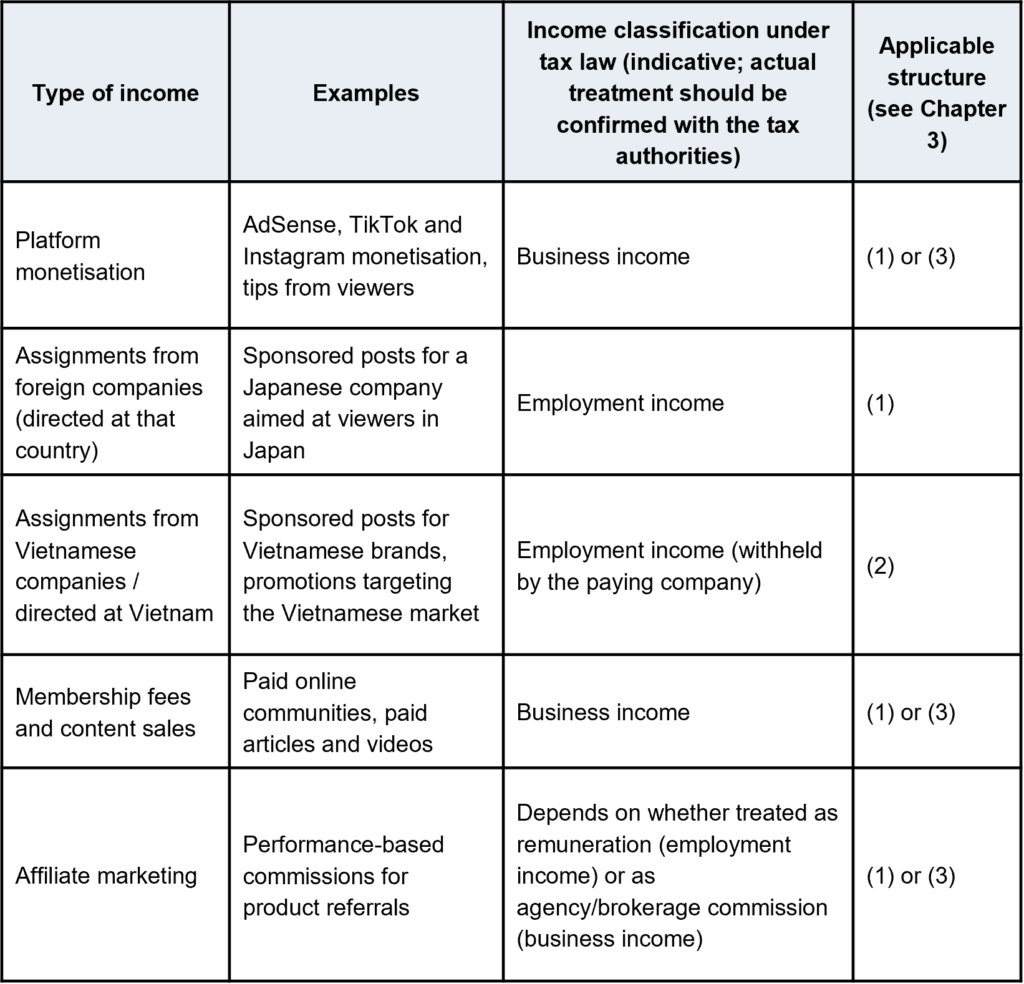
Particular attention should be paid to income that is, or may be, “business income” in the table above: platform monetisation, membership fees and content sales, and affiliate income. Where such income is received in an individual’s own name, it may be taxed as business income depending on its nature, but because foreigners cannot register a business, there is no basis for carrying it on as a business. Whether a foreigner can register for tax as a business individual at all needs to be confirmed with the tax authorities, and it is practically difficult to carry on these activities in one’s own name. To monetise on an ongoing basis, the recipient of the income must be changed to the foreign entity with which one is affiliated ((1)) or to one’s own company ((3)).
3. Three Practical Structures
For foreigners who wish to earn ongoing social-media-related income while living in Vietnam, the practical structures are narrowed down to the following three. Each addresses the employment, residence and tax issues by belonging to an organisation rather than operating as an individual. However, each has its own constraints, and none is an easy option for everyone. Management companies and advertising agencies fall under (1) if they are foreign entities and under (2) if they are Vietnamese entities.
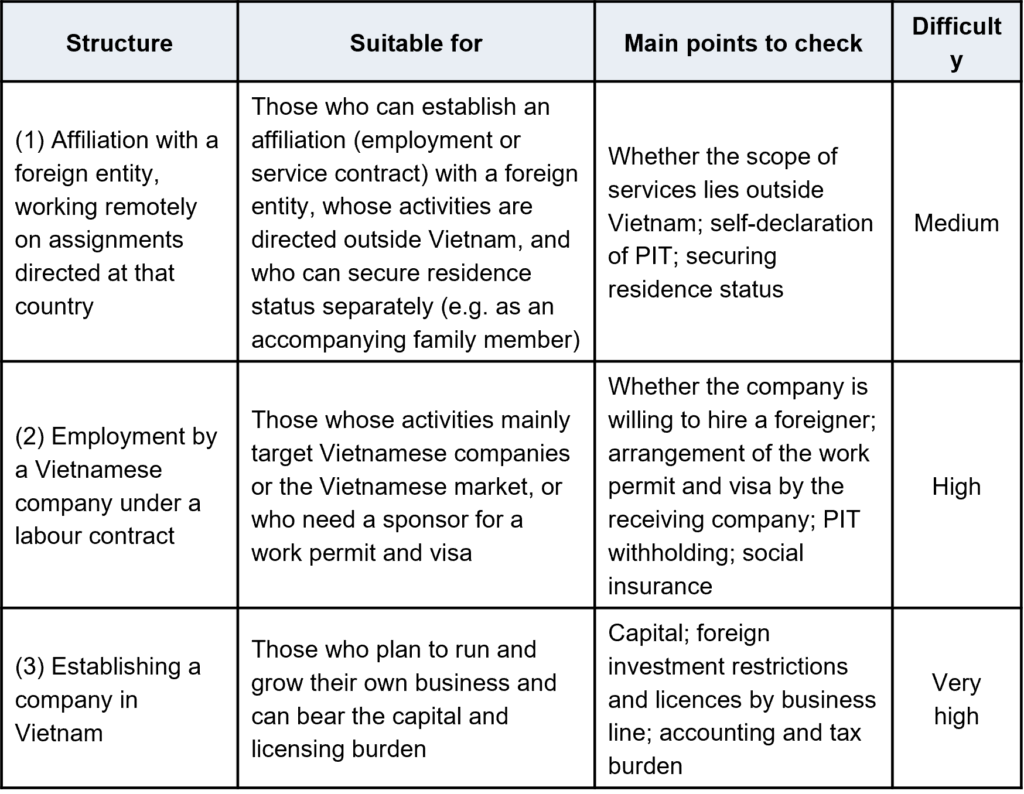
①Affiliation with a foreign entity, working remotely on assignments directed at that country (difficulty: medium)
In this structure, the individual is employed by a foreign company (for example, in their home country) or belongs to an overseas management company, and produces and publishes content for assignments received by that company.
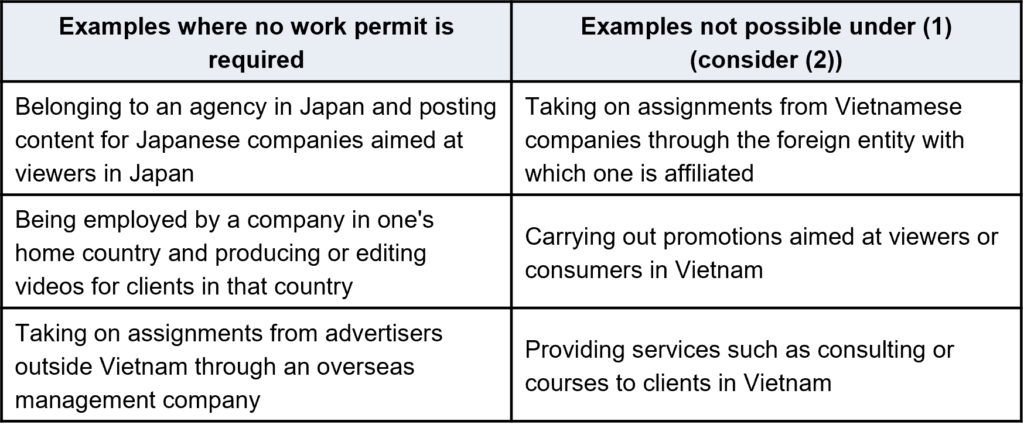
There is no need to set up a company, and the procedures on the Vietnamese side are relatively limited.Whether a work permit is required depends on whether the scope of services includes Vietnam. If a person is affiliated with a foreign entity and only works remotely on assignments directed at that country, a work permit is considered unnecessary. If, on the other hand, services directed at Vietnam are included, a work permit is required; however, a foreign entity with no presence in Vietnam cannot act as the sponsor for a work permit application, so under structure (1) assignments directed at Vietnam cannot in practice be accepted. Those who wish to work for Vietnamese companies or the Vietnamese market need to consider structure (2).
On the tax side, because foreign entities do not normally withhold Vietnamese tax, residents must file quarterly returns and an annual finalisation themselves (Article 22 of Circular 89/2026/TT-BTC). Platform income is treated as remuneration paid by the affiliated entity only where the actual recipient of the revenue is that entity (for example, where the account is in the entity’s name). If the income is received in the individual’s own name, it is the individual’s business income even if a contract has been concluded with the affiliated entity. In that case, the arrangement cannot be regarded as structure (1) and, as explained in Chapter 2, is no different from operating as an individual without a basis for doing business.
As for residence status, a foreign entity does not act as a sponsor for residence in Vietnam. The individual needs to secure long-term residence status separately, for example by accompanying a spouse working in Vietnam; repeatedly entering and leaving on an e-visa is not a basis for long-term residence. Structure (1) is therefore suited to those who can secure residence status separately.
In addition, the affiliated entity should be aware of the risk of being deemed to have a permanent establishment (PE) in Vietnam as a result of the individual’s activities.
②Employment by a Vietnamese company under a labour contract (difficulty: high)
This structure uses a Vietnamese company as the receiving entity. Under a labour contract, the company is the applicant for the work permit, labour visa and temporary residence card, and also handles PIT withholding and social insurance procedures (foreigners are also subject to compulsory participation if certain conditions are met). If the individual authorises it, the company can also carry out the annual tax finalisation on their behalf, so the individual’s tax burden is light.
However, many management companies, advertising agencies and similar businesses in Vietnam work on the basis of service contracts with Vietnamese creators, and few are prepared to employ foreigners, which involves obtaining work permits and enrolling them in social insurance. Those choosing structure (2) should start by looking for a company with experience in employing foreigners. Note that even where a company agrees to employ a foreigner, if it is not familiar with the procedures, the individual will need to engage a consulting firm or similar to handle the work permit and related procedures. Even then, since the applicant is the company, the company’s cooperation is essential. Before signing a contract, it is advisable to confirm whether employment is possible and the extent of the company’s support with procedures.
Note also that a work permit is issued for a specific employer and position, so it covers only work for the employer. If the individual monetises a personal channel or takes on assignments from other companies without going through the employer, the employment and tax treatment of those activities must be reviewed separately.
③Establishing a company in Vietnam (difficulty: very high)
In this structure, the individual contracts with clients through their own company and runs the activity as a business. However, obtaining the Investment Registration Certificate (IRC) and Enterprise Registration Certificate (ERC) often takes several months, and the burden of capital and of post-incorporation accounting and tax filing is also significant.
In addition, foreign investment restrictions by business line must be considered. Even in social-media-related business, producing and publishing advertisements at the request of companies may constitute “advertising services”. Under Vietnam’s WTO commitments, advertising services are a restricted sector in which foreign investors may participate only through a joint venture or a business cooperation contract (BCC) with a Vietnamese advertising business, and they cannot be carried out by a 100% foreign-owned company. Whether a person can set up a company on their own therefore depends on which business line the activity falls under.
Further, although an owner contributing capital above a certain amount (VND 3 billion or more) has the advantage of being exempt from a work permit, setting up a company places a heavy overall burden of procedures and administration on small-scale social media activities and is unlikely to be a realistic option in terms of cost-effectiveness.
Note that whichever of structures (1), (2) or (3) is chosen, attention must be paid not only to compliance with Vietnamese law but also to the tax treatment in the home country. Depending on residence determination and withholding in the home country, double taxation or missed filing obligations may arise, so the tax treatment in the home country should also be confirmed where necessary.
4. Risks and Compliance When Continuing to Operate as an Individual
The main risks expected when continuing to operate as an individual are as follows. Note that they affect not only the individual but also the companies that commission the work.
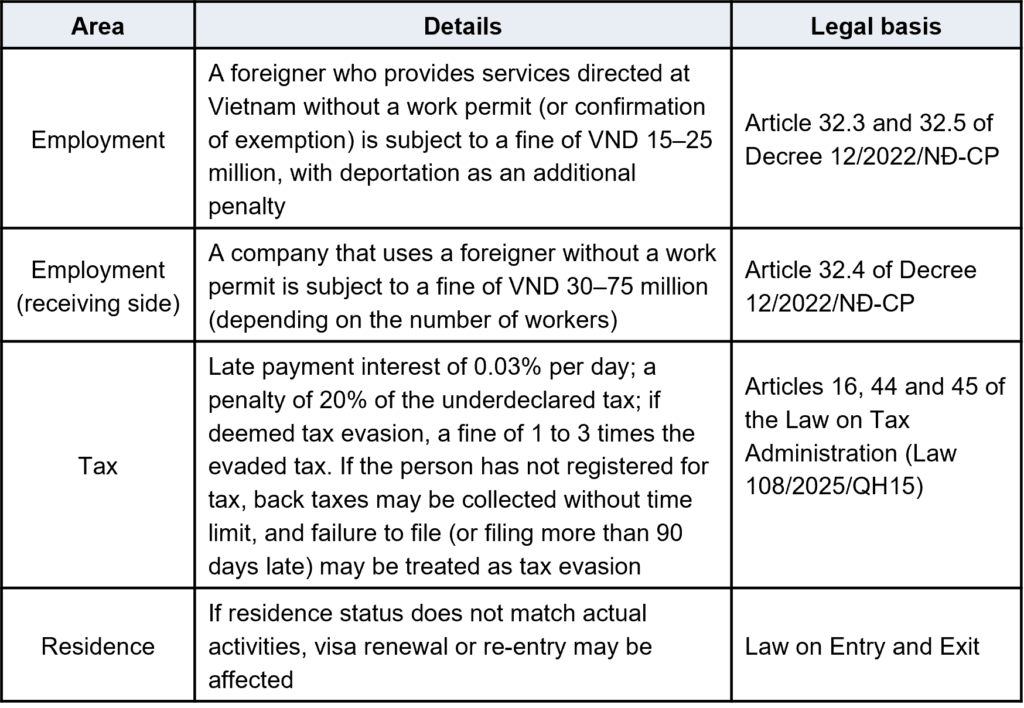
In practice, many foreigners are likely to be continuing social media activities as individuals without having fully checked the legal requirements relating to business registration, employment, residence and tax. However, the fact that no problem has arisen so far does not mean that the activity is lawful. Any breach of the law may lead to fines, tax reassessments or deportation, and may also affect future residence procedures or business plans. Therefore, not only those about to start but also those already earning income should review their current activities and, where necessary, consider moving to an appropriate structure.
Conclusion
Monetising social media may appear easy to start, even for individuals. However, for foreigners living in Vietnam to operate in full compliance with the law, multiple issues must be resolved in business registration, employment, residence and tax, and the hurdles are by no means low.
In practice, three approaches can be considered: affiliation with a foreign entity, employment by a Vietnamese company under a labour contract, or establishing one’s own company, but each has its constraints. Not only those about to start but also those already earning income should review their activities and contractual relationships and consider an appropriate structure.
References
– Law on Personal Income Tax (Law 109/2025/QH15, as amended by Law 09/2026/QH16)
– Decree 253/2026/NĐ-CP: Article 4 (resident individuals), Article 8 (employment income)
– Circular 89/2026/TT-BTC: Article 22 (PIT declaration)
– Law on Tax Administration (Law 108/2025/QH15)
– Decree 168/2025/NĐ-CP: Article 82 (establishment of household businesses)
– Decree 219/2025/NĐ-CP: Article 7.2 (foreign workers in Vietnam)
– Decree 12/2022/NĐ-CP: Article 32 (penalties for violations concerning foreigners working in Vietnam)
– Law on Entry, Exit, Transit and Residence of Foreigners in Vietnam (Law 47/2014/QH13, as amended by Law 23/2023/QH15)
Related Report
・Points to Note About Full Remote Work from Vietnam: The Key to Balancing Family Accompaniment and Career Continuity