
Tax Requirements and Key Points for Debt Offsetting in Vietnam
2026/10/20
- I-GLOCAL.CO.,LTD. Ho Chi Minh City Office
- U.S. CPA
- Yuzuki Watari
Executive Summary
① Offsetting is treated as a method of payment — For Vietnamese tax purposes, an offset is a form of non-cash payment, not a mere bookkeeping entry. If the requirements are not met, the input VAT credit and CIT deduction are denied, and export transactions lose the 0% VAT rate. The 2025 amendments lowered the threshold from VND 20 million to VND 5 million, so far more transactions are now covered.
② Four accepted types and required documents — (a) offset of receivables and payables, (b) offset against loans or payments on behalf, (c) offset through a third party, and (d) payment to a third party designated by the seller (back charge). All require the payment method to be stated in the contract, plus type-specific documents such as debt reconciliation minutes, an offset agreement, or offset minutes signed by all three parties.
③ Advance contractual provision is decisive — An offset clause can be added later by contract appendix, but only before the offset is carried out. Any remaining balance of VND 5 million or more needs separate non-cash payment documents, and receivables in dispute cannot be offset.
④ Typical cases rejected in tax inspections — An agreement prepared only after the fact, offsets made only in the books, the balance paid in cash, a three-party offset documented between two parties, and documents not in place by the payment date. In the last case, input VAT already credited must be adjusted down.
⑤ Offsets with overseas counterparties — Offsetting export proceeds risks losing the 0% VAT rate, and offsetting dividends against export receivables is not accepted (dividends must go through the DICA). Intra-group netting requires three-party documents, and offsetting payments for services triggers foreign contractor tax withholding, with the offset date treated as the payment date.
Introduction
Vietnamese companies routinely have receivables and payables with the same counterparty at the same time. To save the time and fees of bank transfers, it is common practice to offset them and settle only the net balance.
However, for Vietnamese tax purposes, offsetting is not a mere bookkeeping entry but is treated as a method of payment. If the prescribed requirements are not met, neither the input value-added tax (VAT) credit nor the deduction of the expense for corporate income tax (CIT) is allowed, and for export transactions the 0% VAT rate is also denied. Following the 2025 law amendments, the threshold for transactions subject to these requirements was lowered from VND 20 million (approx. JPY 100,000) to VND 5 million (approx. JPY 28,000). Far more transactions are now covered, so companies need to pay closer attention than ever to the tax requirements for offsetting.
This article summarizes, by type of transaction, the requirements for an offset to be accepted for tax purposes, and explains the key practical points.
1. Offset transactions accepted for tax purposes
Under Vietnamese tax rules, an offset that meets certain requirements is recognized as a form of non-cash payment. Therefore, even when receivables and payables are offset without an actual bank transfer, the input VAT credit and the CIT deduction are available if the legal requirements and documentation are met.
In Vietnam, for purchases of goods and services of VND 5 million or more per transaction, the input VAT credit is not allowed without non-cash payment documents. This threshold was lowered from VND 20 million by the Law on VAT (Law No. 48/2024/QH15) and Decree No. 181/2025/ND-CP, effective 1 July 2025. The same threshold applies for CIT under the CIT Law effective 1 October 2025 and its guiding Decree No. 320/2025/ND-CP, and expenses that do not meet the requirements are not deductible. In addition, for export transactions, there is a risk that the 0% VAT rate will be denied if the requirements are not met (see Section 4.I).
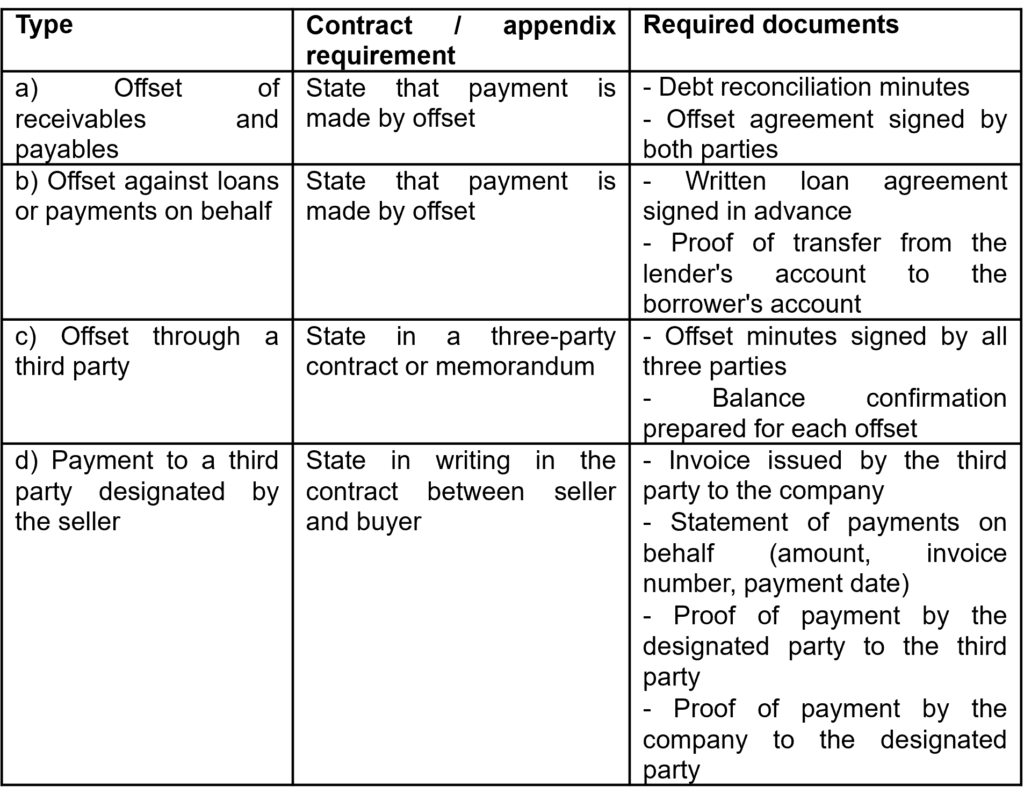
Offsets are accepted only for the types of transactions listed in the regulations. For foreign-invested companies, the following four types are the most relevant in practice.
a) Offset of receivables and payables: the most common type, in which sales and purchase amounts with the same counterparty are offset. This also includes offsets arising from borrowing and lending of goods.
b) Offset against loans or payments on behalf: the purchase price is offset against a loan to the counterparty or an amount paid on behalf of the counterparty at its request.
c) Offset through a third party: a regional headquarters within the group pays the debt on the company’s behalf and offsets it against its own receivables and payables with the company. This is used in groups that have a regional headquarters.
d) Payment to a third party designated by the seller: the buyer pays a third party designated by the seller. A typical example is a back charge, where a forwarder pays shipping lines or port authorities on the company’s behalf and later invoices the total. This applies to companies engaged in import and export.
Strictly speaking, d) is not an offset but an authorized payment. It is covered here because it is often confused with offsetting in practice and requires different documents.
2Documents required for each type of offset
The documents required for each of the four types are as follows. For all types, the payment method must be clearly stated in the contract.
Even if the original contract does not provide for offsetting, the clause can be added later by signing a contract appendix, because under Article 403 of the Civil Code (Law No. 91/2015/QH13), a contract appendix has the same effect as the contract. However, the appendix must be signed before the offset is carried out; signing it retroactively after the offset or after a tax inspection finding is not accepted. Also, for b) offset against loans in the table below, Decree 181 expressly requires a written loan agreement signed in advance, so adding an offset clause by appendix after the loan is made does not meet the requirement.
 If a balance remains after the offset and it is VND 5 million or more, separate non-cash payment documents are required for the remaining amount. If the balance is paid in cash, the input VAT for that portion cannot be credited.
In addition, under Article 379 of the Civil Code (Law No. 91/2015/QH13), receivables that are in dispute cannot be offset. For example, deducting compensation for defective goods from a payable while it is still being negotiated with the counterparty is not a valid offset under the Civil Code, and therefore is not accepted for tax purposes either.
3.Typical cases rejected in tax inspections
Simply offsetting balances in the accounting books is not a valid offset for tax purposes. In practice, many companies have had offsets rejected in tax inspections and been assessed additional tax because the contract did not provide for offsetting or the required documents were not prepared or kept.
Typical cases pointed out in tax inspections are as follows.
– The contract has no offset clause, and only an agreement is prepared afterwards. → This is the most common finding. Preparing only a written agreement after the offset does not meet the requirements unless the contract or an appendix provides for offsetting.
– Balances are only offset in the books, without debt reconciliation minutes or an offset agreement. → Internal books alone cannot prove that payment was made for tax purposes.
– The balance after the offset is paid in cash. → Even if the offset portion meets the requirements, the remaining amount paid in cash is rejected.
– A three-party offset is documented only between two parties. → For an offset through a third party, offset minutes signed by all three parties are required as the basis for the input VAT credit (Point a, Clause 2, Article 26 of Decree No. 181/2025/ND-CP). With only two-party documents, the credit is not allowed even if the actual cash flow can be proven. The CIT deduction is also not allowed, because non-cash payment documents for CIT follow the VAT regulations (Point c, Clause 1, Article 9 of Decree No. 320/2025/ND-CP).
– Documents are not in place by the contractual payment date. → Under Decree 181, if non-cash payment documents are not in place by the payment date, the input VAT already credited must be adjusted down. It can be credited again once the documents are obtained (Official Letter No. 5487/CT-CS dated 25 November 2025), but it is advisable to set the contractual payment date in line with the actual offset procedure.
4.Key points for offsets with overseas counterparties
ⅰ. Offsetting export proceeds may cause loss of the 0% VAT rateExport transactions are subject to the 0% VAT rate and the related input VAT can be refunded, but non-cash payment is required. The two main cases in which an offset is accepted as non-cash payment are an offset against foreign loans registered with the State Bank of Vietnam, and an offset against goods or services purchased from the counterparty.
Other offsets may also be accepted if the prescribed documentation requirements are met (Clause 3, Article 27 of Decree No. 181/2025/ND-CP).We have seen cases where a company wanted to offset a dividend payable to its parent company against export receivables from the parent and settle only the net amount. This does not fall under any of the cases above and is not accepted as non-cash payment. Dividends must be remitted through the direct investment capital account (DICA) (Circular No. 06/2019/TT-NHNN). If such an offset is made, the company loses the 0% VAT rate on the related export sales and the input VAT refund, and also violates foreign exchange regulations.
ⅱ. Intra-group netting requires three-party documentsIn this arrangement, a regional headquarters in Singapore or elsewhere pays the Vietnamese company’s debt to the Japanese head office on its behalf, and then offsets it against its own receivables and payables with the Vietnamese company. In this case, a three-party contract or memorandum, offset minutes signed by all three parties, and a balance confirmation for each offset are required. Without offset minutes signed by all three parties, neither the input VAT credit nor the CIT deduction is allowed, even if the actual cash flow can be proven.
ⅲ. Foreign contractor tax may arise depending on the nature of the offset debtIf the offset amount is a payment for services, there is an obligation to withhold foreign contractor tax (FCT). Because no money is transferred in an offset, the withholding is easily overlooked. In an offset, the offset date is treated as the payment date for FCT.
For per-transaction filing, the tax return must be submitted no later than the 10th day counting from the day after the date the tax obligation arises (the date of the offset minutes) (Clause 1, Article 10 of Decree No. 252/2026/ND-CP).Particular attention is needed for personnel cost charges related to staff transfers within the group. No FCT is imposed on an intra-group transfer based on a secondment order, but if the arrangement is regarded as a service contract, a total of 10% is imposed (5% CIT and 5% VAT). Because the tax rate depends on the form of the contract, it should be reviewed in advance.
Because offsetting involves no movement of money, it tends to be treated lightly within companies as just an accounting entry. However, for Vietnamese tax purposes, documents are required just as for other payment methods, and if the requirements are not met, the offset is rejected for both VAT and CIT. With the lower threshold, more and more transactions will be affected.
What determines whether an offset is accepted is whether the contract or an appendix provided for offsetting before the offset was carried out. Preparing documents afterwards is often not accepted, so advance preparation is essential. If you have any questions about whether your transactions meet the requirements, or about the specific accounting treatment, please feel free to contact us.
Reference
・Law on VAT (Law No. 48/2024/QH15)
・Decree No. 181/2025/ND-CP
・Law on CIT (Law No. 67/2025/QH15)
・Decree No. 320/2025/ND-CP
・Decree No. 252/2026/ND-CP
・Circular No. 06/2019/TT-NHNN
Related Reports
・Non-cash payment evidence under the Value-Added Tax Law (Law No. 48/2024/QH15)