
Capital Gains Taxation in M&A Transactions in Vietnam
2026/08/18
- I-GLOCAL.CO.,LTD Ho Chi Minh City Office
- Hirohito Yamanaka, Yuya Taniguchi
Executive Summary
①What has changed — The amended Law on Corporate Income Tax (Law 67/2025/QH15) took effect on 1 October 2025 and is implemented by Decree 320/2025/ND-CP. Where a foreign enterprise transfers contributed capital in a limited liability company (“LLC”), or shares in an unlisted joint-stock company (“JSC”), the tax is no longer 20% of the gain on transfer. It is now a flat 2% of the transfer price. Because the 2% applies to the gross amount, with no deduction for what the seller originally paid, tax is payable even where the seller sells at a loss.
②The rate depends on who the seller is — For shares in an unlisted JSC, an individual seller is treated as making a “securities transfer” and pays 0.1% of the transfer price; Decree 253/2026/ND-CP confirmed that this rate is unchanged, despite a proposal to raise it during the amendment process. A corporate seller is treated as making a “capital transfer” and pays 20% of the gain if it is a Vietnamese enterprise, or 2% of the transfer price if it is a foreign enterprise. Confirm the seller’s legal form before you fix the transaction structure.
③Exemption for intra-group restructuring — Decree 320 introduced an exemption for intra-group restructurings, and Circular 20/2026/TT-BTC sets out four conditions for it. The wording leaves important questions open — in particular the date at which book value is measured, and how to treat exchange-rate movements where capital was contributed in a foreign currency. Do not assume the exemption applies: confirm the treatment with the managing tax office before you sign.
④Filing deadline, and a cash-flow trap — For foreign enterprises, Circular 20 sets a single deadline: file and pay within 10 days, counted from the day after the first transfer agreement takes effect. The tax can fall due before the seller receives the consideration, so agree in the agreement who funds it and when.
⑤Penalties, and double taxation with Japan — An error in a filing costs the tax shortfall plus a penalty of 20% of the shortfall plus late payment interest at 0.03% per day, and the tax authority can look back up to 10 years. Where a Japanese company sells a Vietnamese subsidiary to another Japanese company, both countries tax the same gain; settle the relief position before signing.
Introduction
Ownership of Vietnamese companies changes hands regularly: a foreign investor buys into the market through an M&A transaction, or a group already operating in Vietnam restructures. In both cases, shares or contributed capital in a Vietnamese company (the “target company”) are transferred to another company or to an individual, and the seller’s gain is taxed in Vietnam. The tax is normally collected not from the seller but from the buyer or the target company (see 2.3). The authorities, industry and other stakeholders have taken differing views on how these gains should be taxed, and the rates and procedures have been amended several times.
The most recent change came with the amended Law on Corporate Income Tax (Law 67/2025/QH15, the “CIT Law”), which took effect on 1 October 2025. For a foreign enterprise transferring contributed capital in a limited liability company (“LLC”), or shares in an unlisted joint-stock company (“JSC”), it replaced 20% of the gain on transfer with a flat 2% of the transfer price. It also introduced an exemption for intra-group restructurings that meet certain conditions. Two implementing instruments followed: Decree 320/2025/ND-CP (“Decree 320”), in force since December 2025, and Circular 20/2026/TT-BTC (“Circular 20”), which sets out the detailed filing rules and has been in force since March 2026. This report explains what these changes mean in practice: which rate applies to whom, how the tax base is calculated, who files and by when, what the exemption requires, and what happens if you get it wrong.
1. How the Vietnamese Rules Work in Practice
The diagram below sets out the main steps in a Vietnamese M&A transaction carried out by acquiring shares or contributed capital. The capital gains filing and payment covered by this report come at the very end of the process, after signing and closing.
【The main steps in a Vietnamese M&A transaction carried out by acquiring shares or contributed capital】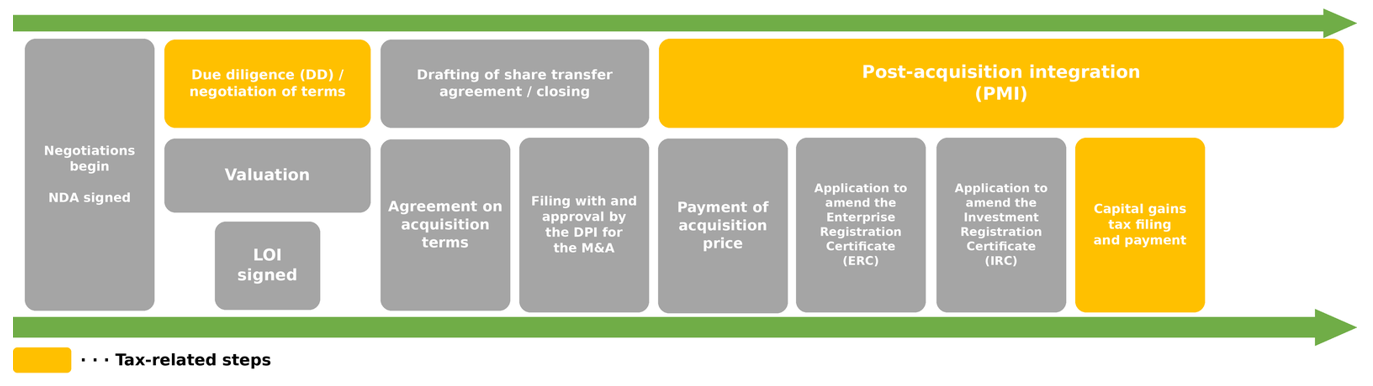
1-1 Which Taxes Apply, and at What Rate
An M&A transaction carried out by acquiring shares or contributed capital is treated for tax purposes as a transfer of an equity interest. Two taxes can apply: personal income tax and corporate income tax. The tax falls on the seller — the buyer is simply purchasing an asset and owes no tax of its own on the deal. The buyer or the target company may nevertheless have to declare and pay the seller’s tax; see 2.3.
The tables below summarise the tax charged on the seller.
【Seller: an individual (personal income tax)】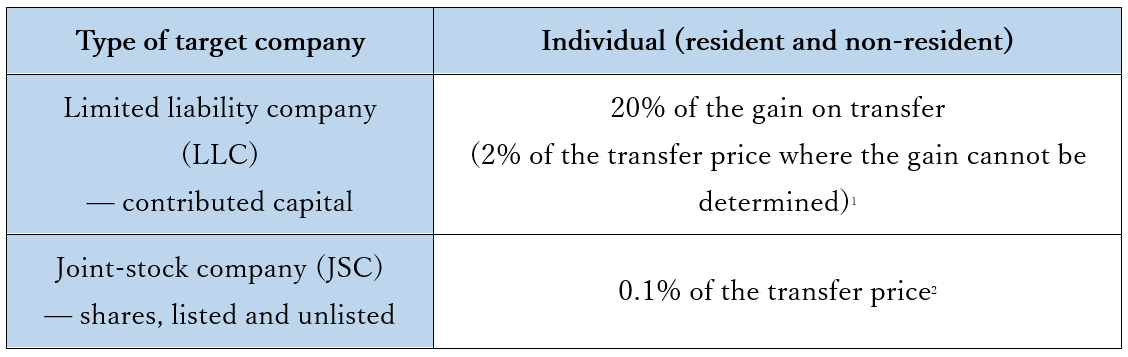
【Seller: a company (corporate income tax)】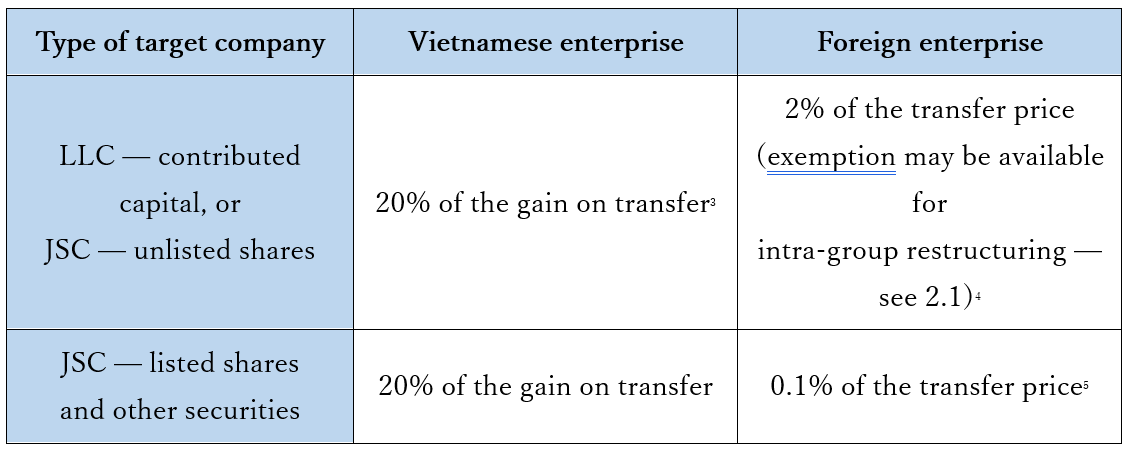 [1] Law on Personal Income Tax 109/2025/QH15, Article 13.1 (residents) and Article 23.1 (non-residents); Decree 253/2026/ND-CP
[2] Law on Personal Income Tax 109/2025/QH15. A transfer by an individual of shares in an unlisted joint-stock company is treated as a securities transfer.
[3] Law on Corporate Income Tax 67/2025/QH15, Article 11.2; Decree 320/2025/ND-CP, Article 13. A transfer by a legal entity of shares in an unlisted joint-stock company is treated as a capital transfer.
[4] Decree 320/2025/ND-CP, Article 12.3(i). The conditions for the exemption are set out in Article 7.2(m) of the New Circular 20.
[5] Decree 320/2025/ND-CP, Article 14
The two tables diverge on one point that is easy to miss: a transfer of shares in an unlisted JSC is classified differently depending on who the seller is. For an individual seller it is a “securities transfer”, taxed at 0.1% of the transfer price. For a corporate seller it is a “capital transfer”, taxed at 20% of the gain for a Vietnamese enterprise and 2% of the transfer price for a foreign enterprise. Because the rate turns on this, confirm the seller’s legal form before you fix the transaction structure.
Example. A foreign enterprise acquired contributed capital in a Vietnamese LLC for USD 5 million and sells it for USD 4 million. Under the former rules there was no gain, and so no tax. Under the new rules the tax is 2% of USD 4 million, or USD 80,000, even though the seller has made a loss of USD 1 million.
There is one exception for foreign corporate sellers. Article 12.3(i) of Decree 320 (Article 12, Clause 3, Point i) exempts intra-group restructurings that meet certain conditions, and Article 7.2(m) of Circular 20 sets out what those conditions are. All four must be met.
(a) There is no change in the ultimate beneficial owner (the parent company).
(b) The transfer price does not exceed the book value or the initial contributed capital.
(c) The transaction produces no difference in value, and the value determined under the approved restructuring plan does not exceed the book value.
(d) The transferee takes over the full capital value, together with all rights and obligations.
Two questions are left open by the wording. First, the rules do not say at what date the “book value” in condition (b) is measured. Second, they do not say how to treat movements in book value caused by exchange-rate fluctuations where capital was contributed in a foreign currency. Do not assume the exemption applies. Confirm the treatment with the tax office that supervises the target company (the managing tax office) before you sign, and keep the response on file.
Turning to individual sellers. The March 2026 draft of the decree implementing the amended Law on Personal Income Tax (Law 109/2025/QH15) proposed taxing the gain on transfers of unlisted shares at 20%. The decree as issued — Decree 253/2026/ND-CP — did not adopt that proposal: unlisted shares remain taxed at 0.1% of the transfer price. For an individual seller, whether resident or non-resident, neither the rate nor the classification has changed.
1-2 How the Tax Base Is Calculated
The transfer price is the amount agreed in the share or capital transfer agreement, or in an equivalent document. It means the consideration for the transfer; it is unrelated to transfer pricing between related parties, which is governed by separate rules and is outside the scope of this report.
The gain on transfer is calculated as: transfer price – acquisition cost – transfer-related expenses.
The acquisition cost is the amount the seller contributed, or the price it paid to acquire the interest from a third party. Transfer-related expenses are costs actually and directly incurred on the transfer — legal and tax advisory fees, and government filing and registration fees. To deduct them, you need supporting documents such as contracts and invoices.
Losses attract scrutiny. Where a transfer produces a loss, we regularly see the tax authority challenge the price — either when the return is filed or later, in a tax audit — and substitute its own market valuation, which then becomes the tax base. Before you file, prepare evidence that the price is objective and reasonable, such as a valuation report from an independent professional firm.
One practical trap deserves attention. Capital is often contributed to the target company in a foreign currency such as US dollars, and the sale is then made in the same currency. Even where there is no gain in that currency, converting the figures into Vietnamese dong can produce a taxable gain. The current rules do not fully settle which exchange rate applies, so fix the rate with your tax adviser before signing and, where the amounts are material, confirm it with the managing tax office.
1-3 Who Pays, and by When
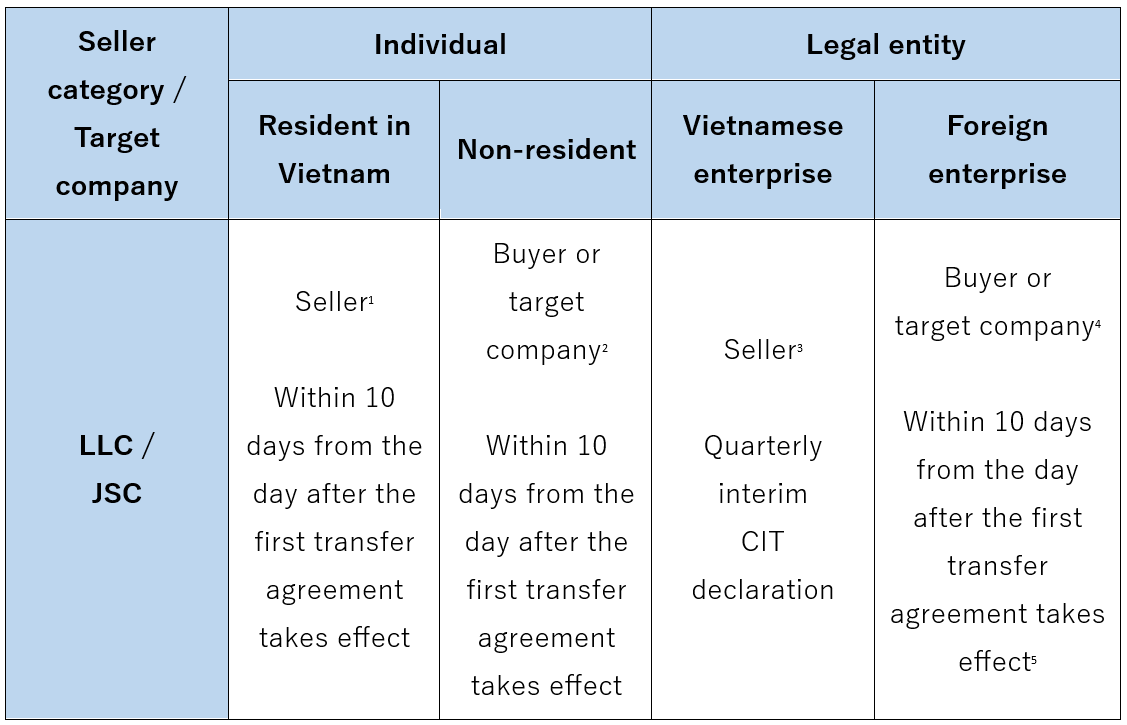
As a general rule, the seller is the taxpayer. There is an important exception for foreign sellers, who in practice often cannot obtain a Vietnamese tax code or pay the tax by remittance from overseas. In that case the buyer, or the target company in Vietnam, is designated as the taxpayer and pays on the seller’s behalf.
【Taxpayer and payment deadline, by category of seller】
 [6] Circular 87/2026/TT-BTC、Decree 253/2026/ND-CP
[7] Decree 252/2026/ND-CP, Article 10.1; Circular 87/2026/TT-BTC
[8] Decree 252/2026/ND-CP, Article 9.2(a)
[9] Decree 320/2025/ND-CP, Article 2.2
[10] Circular 20/2026/TT-BTC, Article 5.2(a); Decree 252/2026/ND-CP, Article 10.1; Law on Tax Administration 108/2025/QH15, Article 14.1(a)
The deadline for foreign enterprises has changed. The old rule offered two possible starting points: (a) the date on which the licensing authority approved the capital transfer, or (b) where no approval was required, the date agreed in the contract. Circular 20 replaced these with a single starting point — the effective date of the first transfer agreement. The counting method also changed: the 10 days now begin on the day after that date, rather than on the date itself.
Technical note. The decrees now in force no longer contain an express provision requiring corporate income tax on a capital transfer to be declared transaction by transaction. Decree 126/2020/ND-CP, which used to list the taxes subject to such declaration, has been repealed, and its successor, Decree 252/2026/ND-CP, only defines a tax period arising on each occurrence. In our experience this changes nothing in practice: Circular 20 fixes the point at which revenue is recognised for each capital transfer, so the tax is still declared transaction by transaction, and the tax authority continues to administer it that way.
Listed securities traded through a broker work differently. Where shares in a public company are bought and sold through a securities company, none of the above applies: the securities company withholds the tax through the securities account.
Watch the cash flow. Depending on when the tax falls due and how the deal is structured, the filing and payment may be required before the seller receives the transfer consideration. Agree in the transfer agreement who funds the tax and when, and make sure the cash is available before the deadline.
1-4 What You Must File
A corporate income tax filing for a capital transfer consists of:[11]
ⅰ. Corporate income tax return for the capital transfer
ⅱ. Copy of the transfer agreement (if it is in a foreign language, a Vietnamese translation of the principal terms)
ⅲ. Copy of the licensing authority’s decision approving the transfer
ⅳ. Copy of the Certificate of Contributed Capital
ⅴ. Supporting documents for the transfer-related expenses claimed
The tax authority routinely asks for more. Have these ready before you file: a copy of the Enterprise Registration Certificate (ERC), and bank statements evidencing receipt of the transfer consideration. Where personal income tax applies, substantially the same documents are required.
[11] Circular 21/2026/TT-BTC (Form 05/TNDN)
1-5 Penalties
Getting this wrong is expensive.
ⅰ. Omission or error in a filing: the tax shortfall (the correct amount less the amount already paid), plus a penalty of 20% of the shortfall, plus late payment interest at 0.03% per day.
ⅱ. Tax evasion or fraudulent conduct: an aggravated penalty of between 100% and 300% of the shortfall, and an administrative fine of up to VND 200 million (approximately JPY 1 million) may also be imposed.
The tax authority can assess arrears and late payment interest retroactively for up to 10 years, so on a large transaction the exposure can be substantial.
1-6 Double Taxation on Japan-to-Japan Sales
Now take a Japanese company selling its Vietnamese subsidiary to another Japanese company. Japan taxes the gain on the share transfer under Japanese law. Vietnam taxes the same transfer at 2% of the transfer price (see 2.1). The same gain is therefore taxed twice.
The Japan–Vietnam tax treaty provides a framework for relieving this double taxation through a foreign tax credit. In practice, however, we have seen claims made on the Vietnamese side attract extended requests for additional documents and explanations from the tax authority. We therefore recommend establishing before signing whether the credit can be claimed in Japan, and pricing the Vietnamese tax into the deal if it cannot.
Conclusion
This report has covered the main changes to capital gains taxation made by the CIT Law, effective 1 October 2025, and by Decree 320, together with the implementing rules in Circular 20 and the position for individual sellers confirmed by Decree 253.
Vietnam continues to offer Japanese companies significant opportunities, both as a manufacturing base and as a market, supported by its geopolitical stability and its continuing economic growth. The government encourages foreign investment; at the same time, the tax authority is working actively to secure revenue, and these amendments are part of that trend. We hope this report helps you understand the changes, assess and manage the tax risk, and get the result you expect from your transaction.
Related Reports
・Vietnam M&A Report – Part 1 Overview of economic situation and notable sector