
Vietnam M&A Report – Part 1 Overview of economic situation and notable sector
2026/08/05
- I-GLOCAL.CO.,LTD ハノイ事務所
- Shuya Kondo
Executive Summary
① Vietnam is one of Asia’s fastest-growing economies, with real GDP growth of 8.02% in 2025 and GDP per capita surpassing USD 5,000 for the first time. Backed by a population of nearly 100 million with a young age profile, a network of more than 15 free trade agreements, and the ongoing “China Plus One” trend, Vietnam is raising its profile as a compelling investment destination—even as M&A activity across Southeast Asia as a whole remains subdued.
② The most active sectors for M&A at present are healthcare, real estate and industrial parks, consumer goods and retail, fintech and technology, manufacturing and semiconductors, and renewable energy. Vietnam is moving beyond its traditional role as a low-cost production base and shifting the focus of investment toward higher-value-added sectors.
③ As a market-entry strategy, a growing number of foreign companies are choosing M&A over greenfield investment, which takes more time. At the same time, careful attention should be paid to aging in major cities, the middle-income trap, infrastructure shortfalls, and rising labor costs.
Introduction
In recent years, an increasing number of companies have chosen Vietnam as an investment destination due to its rapid economic growth, young and abundant workforce, and expanding consumer market. Actually, M&A activity targeting Southeast Asia (SEA) area has been relatively weak recently. A net amounts of cross-boarder M&A transaction toward SEA in 2025 was USD 11 billion, which was slight decrease from USD 12 billion in prior year (2024)[1] due to tariffs change and a cautious global capital environment. On the other hand, M&A activity targeting Vietnam stayed relatively strong. A net amounts of cross-boarder M&A transaction toward Vietnam in 2025 was USD 854 million, which was 56% increase from prior year[2]. This suggests that many companies are still drawn to the Vietnamese market and keen to invest there.
In this report, we provide an overview of the current state of the Vietnamese economy, the sectors currently attracting the most M&A activity, and the practical benefits and considerations of acquiring a Vietnamese business. We hope this report will be helpful for companies, considering M&A in Vietnam.
[1] UNCTAD “Global Investment Trends Monitor No.50” (January 2026) P13
[2] UNCTAD World Investment Report | UN Trade and Development (UNCTAD) Annex table 05
1. Overview of the Vietnamese Economy
Vietnam is currently one of the fastest-growing economies in Asia. Real GDP growth reached 8.02% in 2025, the second-highest annual rate of the 2011-2025 period after 2022, while the manufacturing and processing sector grew by 9.97%—the highest in six years. Nominal GDP reached approximately USD 514 billion, and GDP per capita exceeded USD 5,000 for the first time, at USD 5,026[3]. The government has set an ambitious target of at least 10% annual growth through 2030, supported by significant infrastructure investment and ongoing reforms to attract foreign capital. At the 13th National Congress of the Communist Party of Vietnam also, the Vietnamese government set a long-term goal of becoming a high-income developed country by 2045.
This significant growth are built on the Doi Moi reforms launched in 1986, which opened Vietnam to foreign investment and led to the gradual development of capital markets, accounting standards aligned with international practice, and an extensive FTA network—the foundations that today support cross-border M&A.
Political stability is another factor often cited by foreign investors. The single-party system led by the Communist Party of Vietnam has provided consistent long-term policy direction for nearly four decades.
Three structural factors underpin this growth:
- The “China Plus One” strategy is accelerating, with multinational manufacturers relocating production capacity to Vietnam to diversify away from a single-country supply base.
- Domestic consumption is expanding rapidly, supported by a population of approximately 100 million with a median age of 34.
- Vietnam’s extensive network of free trade agreements—including CPTPP, EVFTA, and RCEP, with 15 or more FTAs in total—continues to drive trade and investment.
Inflation remains well-controlled at 3.31%, within the government’s target range, indicating broad macroeconomic stability. Registered foreign direct investment reached USD 38.4 billion in 2025, essentially flat with the prior year, of which USD 27.6 billion was actually disbursed—largely into the manufacturing sector[4].
Importantly, Vietnam is moving beyond its traditional positioning as a low-cost manufacturing base and is now actively building capabilities in higher-value-added areas such as semiconductors, digital services, and healthcare. Leading global companies including NVIDIA, Samsung, Google, and SpaceX have either established or expanded their presence in Vietnam. The table below summarizes the key economic indicators.
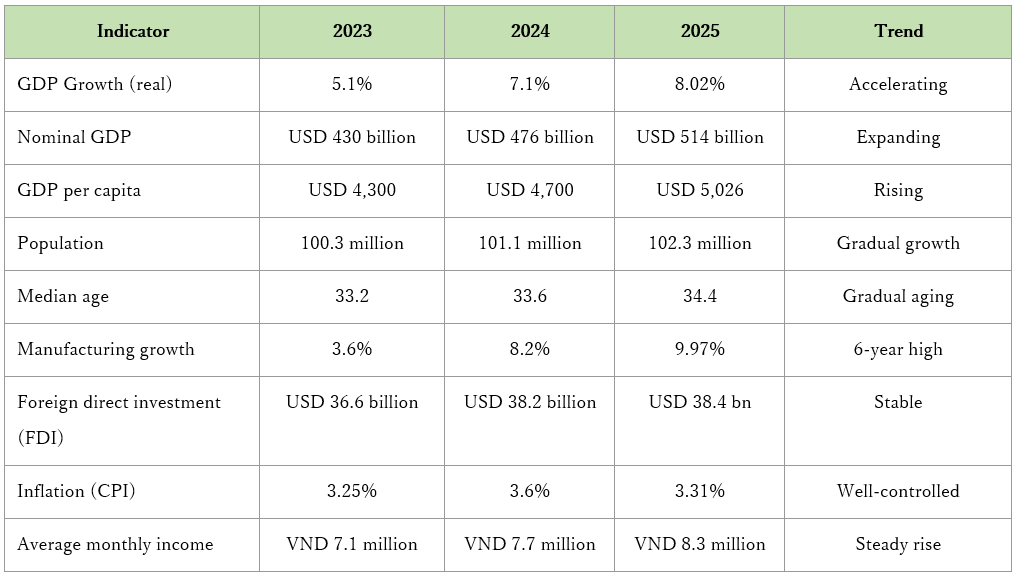 Compiled by the author from the National Statistics Office of Vietnam, UN World Population Prospects 2024, IMF World Economic database
[3] National Statistics Office of Vietnam (NSO/GSO), “Socio-economic Situation in the Fourth Quarter and 2025” (January2026). https://www.nso.gov.vn/en/data-and-statistics/2026/01/socio-economic-situation-in-the-fourth-quarter-and-2025/
[4] National Statistics Office of Vietnam (NSO/GSO), “Socio-economic Situation in the Fourth Quarter and 2025” (January2026).https://www.nso.gov.vn/en/data-and-statistics/2026/01/socio-economic-situation-in-the-fourth-quarter-and-2025/
2.Hot Sectors for M&A
The following sectors have attracted the most M&A activity in Vietnam in 2024 and 2025, both by deal count and by transaction value.
(1) Healthcare
Healthcare is among the most actively pursued M&A targets in 2024–2025. Vietnam’s hospital-bed and specialist-physician density remain low level, while rising household incomes and rapid population aging are driving steady growth in private healthcare spending. Notable transactions include Ares Management’s acquisition of Medlatec Group (approximately USD 150 million) and KKR’s majority investment in Saigon Medical Group. Active sub-sectors include hospital and clinic networks, diagnostics, healthtech, and elderly care.
(2) Real Estate and Industrial Parks
Real estate accounted for approximately 36% of total M&A deal value in 2024, the single largest sector. Demand for industrial parks and logistics facilities is particularly strong, driven by urbanization and manufacturing relocation from China. The 2024 amendments to the Land, Housing, and Real Estate Business Laws have meaningfully expanded access to land use rights for foreign-invested enterprises. Notable deals include Birch’s acquisition of Eastern Real Estate (USD 365 million) and CapitaLand’s acquisition of a Binh Duong residential complex (approximately USD 553 million).
(3) Consumer Goods and Retail
With a population of over 100 million and a rapidly expanding middle class, consumer goods and retail have become core M&A targets. The consumer sector’s share of total M&A deal value rose from 16% in 2024 to 21% in Q1 2025. With GDP per capita above USD 5,000, consumers are shifting from quantity to quality. Notable transactions include Japan’s Kokuyo Group’s acquisition of up to 65% of Thien Long Group (approximately USD 178 million, December 2025), and Thailand’s F&N further increasing its stake in Vinamilk.
(4) Fintech, Tech and Digital Services
Vietnam has low credit card penetration, limited consumer lending, and below-average insurance uptake—creating a long runway for growth in financial services. Fintech (digital payments, BNPL, and insurtech) is largely outside the 30% foreign-ownership cap that applies to commercial banks, allowing more flexible entry structures. A USD 200 million Series E led by Japan’s Mizuho Bank valued a leading super-app at over USD 2 billion, making it Vietnam’s fourth unicorn. Beyond fintech, broader digital services (EdTech, HealthTech, and B2B SaaS) are also active, supported by digital transformation initiatives and a young, digitally fluent population—exemplified by the NVIDIA-FPT partnership to build Vietnam’s first AI factory (approximately USD 200 million).
(5) Manufacturing and Semiconductors
Manufacturing and processing posted 9.97% growth in 2025, the fastest pace in six years, benefiting most directly from the China Plus One trend. The government’s Semiconductor Industry Development Strategy (Decision No. 1018, 2024) provides preferential tax, land, and import-export treatment for operators in designated high-tech zones through 2030. Recent transactions include GS Microelectronics’ acquisition of Sinble Technology Vietnam and SK Group’s investment in Iscvina Manufacturing.
(6) Renewable Energy
Renewable energy is increasingly active, driven by Vietnam’s net-zero by 2050 commitment and the Revised Power Development Plan VIII (Decision 768/QD-TTg, April 2025), which significantly raised targets for wind, solar, and battery storage and reintroduced nuclear into the energy mix. New regulations on Direct Power Purchase Agreements (Decree 57/2025) and rooftop solar (Decree 58/2025) have expanded entry routes for foreign investors. Notable 2025 deals include SARA’s acquisition of the Dam Nai wind project (USD 40 million), Levanta’s acquisition of HBRE Gia Lai Wind Power (USD 33.1 million), and Sumitomo’s entry into hydropower via Cuu Long Power Engineering.
3.Benefits of Acquiring a Vietnamese Company
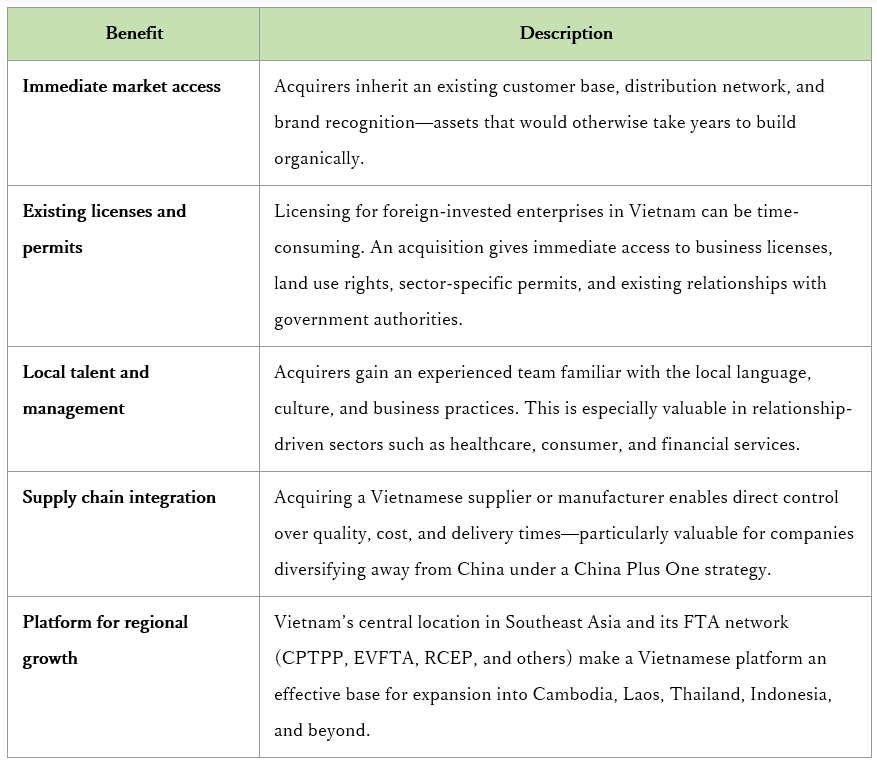
An increasing number of foreign corporates are choosing M&A over greenfield investment as their preferred mode of entry. The principal benefits are summarized below.
4.Challenges and Catalysts in the future
Several practical considerations deserve careful attention:
1.Urban aging
While the national median age remains around 34, major cities such as Hanoi and Ho Chi Minh City are already showing clear signs of demographic aging, mirroring patterns seen earlier in other East Asian economies. Vietnam’s demographic dividend has a defined shelf-life, and policy focus is gradually shifting toward productivity-led growth.
2.Middle-income trap
Growth to date has been driven heavily by foreign-invested enterprises, particularly in export manufacturing. Even now, there are some symbolic Vietnamese companies, such as Vin Group, FPT group. However, for Vietnam to graduate to high-income status, more emergence of domestic champions delivering higher value-added products and services will be essential.
3.Infrastructure gap
Delays in metro construction in major cities, persistent traffic congestion, and uneven port and power capacity continue to weigh on competitiveness, even as new highways, airports, and renewable energy projects come online. The current administration’s reform momentum is expected to gradually narrow this gap.
4.Labor cost increasing
Wages in Vietnam have risen steadily, with the GSO reporting average monthly income up roughly 8% annually—from approximately VND 7.1 million (USD 271) in 2023 to VND 8.3 million (USD 317) in 2025. With GDP per capita above USD 5,000, Vietnam is no longer the lowest-cost option among ASEAN production bases, so the rationale for entry is shifting from labor arbitrage toward higher value-added activities such as engineering, R&D, and digital services.
Conclusion
Vietnam offers a rare combination for foreign corporates: sustained high growth, favorable demographics, and an actively improving regulatory environment.
While the challenges outlined above are real, the government is actively addressing them through ongoing reforms across administrative, land, and energy regulation. In parallel, rising household investment in education—particularly English-language education—is gradually lowering the language barrier for foreign investors, especially when working with younger management talent in major cities.
In our next report, we will discuss the practical aspects of executing M&A in Vietnam in greater depth—including deal timelines and common findings from financial, tax, legal, and operational due diligence.