Vietnam M&A Report Part 3 ― Post-Merger Integration
2026/10/02
- I-GLOCAL.CO.,LTD. Hanoi Office
- Shuya Kondo
Executive Summary
① PMI can be divided into 3 groups. Management-side work protects the value that was bought. Business-side work creates new value. The relationship with the target company makes both of them possible. The first two are both necessary, and neither one is less important. The difference is how close they are to the synergies. Business-side work creates them directly, so the buyer should not spend all of its time on the management side.
② This report explains the business-side work for each type of synergy. For revenue synergies, the important factors are the customers, the products, the sales channel and the KPIs. For cost synergies, they are the suppliers, inventory control, the purchasing flow and the KPIs. However, none of this works well without a good relationship with the target company.
Introduction
Our first report explained Vietnam’s economy and the sectors with the most M&A activity. Our second report explained how a transaction is carried out in Vietnam, including the deal timeline and the issues that often appear in due diligence. This third report looks at PMI (Post Merger Integration) after closing, which decides whether the expected synergies appear or not. The buyer bought the Vietnamese company because it expected some kind of synergy, but a synergy does not appear by itself. The buyer has to carry out the activities that produce it, and those activities are PMI.
1. What PMI Actually Is
When people hear the word PMI, they often imagine something large, such as redrawing the organization chart, reducing headcount or merging IT systems. In practice it is a long series of small and plain tasks, and not the work of one department only. Accounting, human resources, sales, IT and legal are all involved at the same time. Communication with employees is part of PMI as well.
PMI therefore covers a very wide range of activities, but we can divide them into 3 groups from our experience as below.
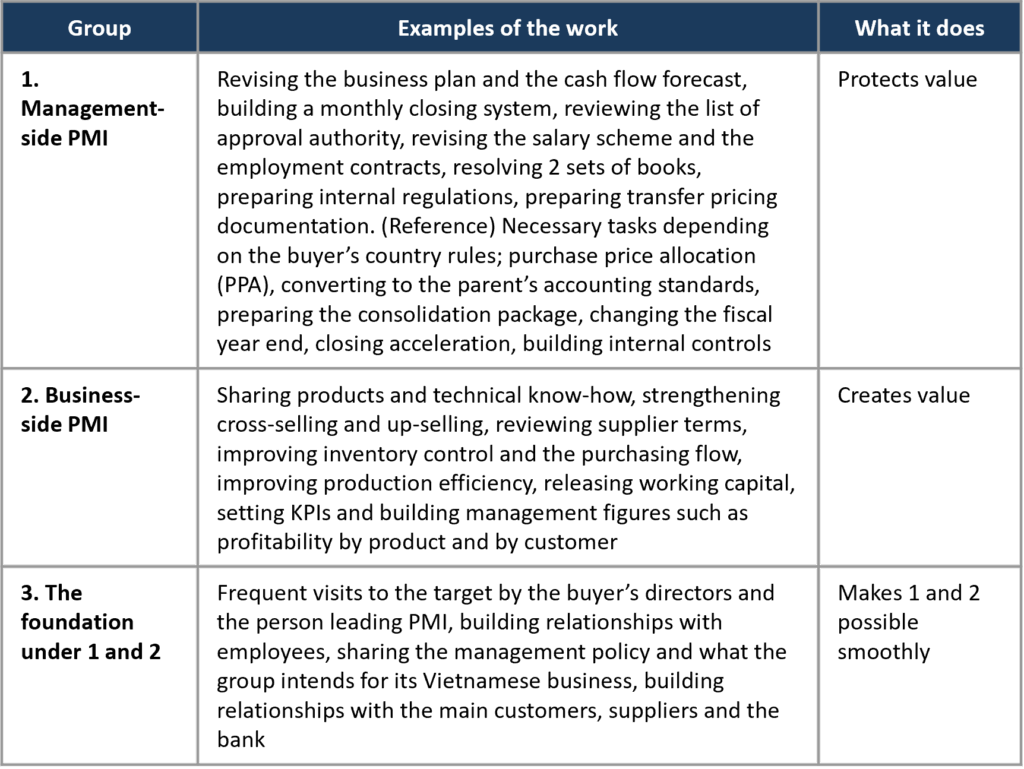 Group 1 is the conservative side of PMI and group 2 is the active side. This is only a difference of viewpoint, and it does not mean that group 1 is less important. Group 3 is the base for both. We recommend concentrating on group 3 first after closing, and then pushing group 1 and group 2 forward together.
2.Management-side PMI
The business plan and the cash flow forecast should be reviewed early. How much work this takes depends on how far the target has already prepared them. In many local companies, a cash flow forecast has never been prepared, or it is based on very aggressive assumptions, so forecast and actual become very different. This is important, because a company can go bankrupt when it runs out of cash, even if it reports a profit. A monthly closing system is also needed. Unlisted companies in Vietnam are not required to have an audit. Even when they do a monthly closing, the figures are often not accurate, or the closing date is very late. In most cases this has to be improved.
Some internal regulations (transfer pricing documents, internal labor regulations, personal data protection documents and others) are also required by Vietnamese law. Without them, the company will receive a penalty and will be in a weak position in a tax audit. The list of approval authority is also worth reviewing early. Decisions in Vietnamese companies are usually made from the top, and most of the approval authority is often held by one person such as the CEO. In our experience, many of them really review every transaction and every payment by themselves. The problem is that this depends on one person, and the company cannot grow beyond the capacity of that person. Some of the authority therefore has to be given to others. The usual way is to set an amount and let managers or team leaders approve the items below it. Two more items are necessary in some cases. If the target has kept 2 sets of books, it must move to one set. If the salary scheme has been arranged to reduce the social insurance contribution, the scheme and the employment contracts have to be revised. For details, please refer to our part 2 report.
3.Business-side PMI
A synergy is the new value created by combining the acquired business with the buyer’s existing business and resources. There are many types of synergy, but we look at the 2 types that a foreign company buying a Vietnamese company usually expects: revenue synergies and cost synergies. Below we explain the PMI work for each of them. Synergies are very different by industry, but we focus mainly on manufacturing and wholesale.
3.1 Revenue synergies
A company that buys a Vietnamese business usually expects to use the network of the target company to sell its own products in this fast growing market, and so to increase the revenue of the group. Below we introduce some PMI actions for this, from 4 angles: the customers, the products, the sales channel and the KPIs.
Customers
In Vietnam, a salesperson usually talks with the customer’s contact person directly through Zalo or a similar chat application. For this reason, only that salesperson knows what the customer needs, what the customer has trouble with, and when the customer plans to buy. This information is not in any system, and often not written down at all. The first task is to collect it into one customer list that everybody can see. The list should include the revenue and the gross margin, who decides the purchase, when the budget is decided, what the customer asked for in the past, and the problems still not solved. This is the only way for the buyer to find where its own products can fit. It also keeps the relationship with the company, not with one person who may leave later.
Products
The buyer should then use this list to study which of its products can really solve a problem of the customer, and start cross-selling and up-selling from there. This is difficult if the local sales team does not have deep product knowledge. Customers get catalogue data easily and already understand the basic specifications. What they cannot get is which of their problems the product can solve, and the training has to reach this level. Training materials in Vietnamese and one engineer on the buyer’s side who can answer technical questions quickly are necessary for the same reason. The existing products should also be reviewed. When the relationship with a customer is very long, the price is sometimes not reviewed for many years, and we often find products sold at a large loss. These prices should be revised. If a customer would stop the business because of a price increase, the buyer should also consider ending the contract.
Sales channel and sales flow
The buyer has to decide the route to the customer: direct sales, a distributor, an agent, or the target’s existing trade flow. Two points need care. The first is a conflict with the existing channel. Distributors and agents sometimes have an exclusive right for one area, and if the same product reaches one customer at 2 different prices through 2 routes, the customer will notice. The second is who does the actual work: who accepts the order, who issues the invoice, where the inventory is kept, who delivers and who handles claims. The accounting, legal and logistics teams should join this discussion too. The internal sales flow also needs the same review. In Vietnam, one salesperson often handles everything alone, and the quotation and the purchase order are often not kept as data anywhere. A person in charge should be decided for every step: who proposes, who joins the visit, who makes the quotation, who approves the price, and who takes care of the customer after the order. This is not only to organize the work. When several people are involved, another person can notice a sale with a very low margin or a simple mistake, so it also helps to find errors and fraud.
KPIs
Many companies already use the number of orders, the revenue and the gross margin by product and by customer as KPIs, and review them in the sales meeting. This is worth doing, but it only shows the result after the event. We therefore recommend connecting the activity with the result. If the company records the number of proposals together with the number of orders, it can find a salesperson whose success rate is low, and give advice on which part of the sales approach is weak. The company should also count the orders from cross-selling and up-selling, and the sales of new products introduced after the acquisition. These numbers make the synergy visible. The new products also need their own sales target, and the company must write down whose sale it is. If this rule is not clear, the safest way for a salesperson is to keep selling the existing products.
3.2 Cost synergies
Here the buyer usually expects to reduce the manufacturing cost, and to improve production efficiency by sharing technical know-how. Below we explain the PMI work for this, from 4 angles: the suppliers, inventory control, the purchasing flow and the KPIs.
Suppliers
In Vietnam, when the relationship with a supplier is very long, the trading terms are sometimes clearly bad for the company: the lead time is long, the payment term is short, or the unit price is much higher than the market. In some cases the purchasing staff receives a kickback personally in return. The first step is to collect the trading terms of all suppliers and find the ones that are not normal. The company should then negotiate, and end the contract if the negotiation does not work. The number of suppliers for each material should also be checked. We often see a company that has bought one material from only one supplier for many years, and has never asked another supplier for a price. Buying the same material from 2 or 3 suppliers is a normal and recommended practice, so the company should change to a system that always takes quotations from several suppliers.
Inventory control
The quantity of material received at delivery should be compared with the quantity that later goes into production. If there is a gap, the storage may be bad and the material may be lost before use, for example by evaporation. The gap may also come from theft. We do not see it often, but some companies do not keep perpetual inventory records at all. They count the stock only at the beginning and the end of the month, and calculate the material used backwards from the difference. With this method the company cannot find material stolen during the month. It should change to perpetual records, so that every receipt and issue is recorded when it happens.
Purchasing flow
When goods arrive at the warehouse, the quantity received is often not checked against a proper document, but against a quantity the purchasing staff told the warehouse verbally, with no formal purchase order behind it. This information may be wrong, and the inventory check above also becomes useless. The flow should be revised so that the warehouse always checks the goods against the formal purchase order. Purchasing has the same problem as sales. One person often handles everything from the order to the delivery, through a chat application such as Zalo. More than one person should be involved, and the person who compares the quotations should not be the person who places the order. In many companies the same staff has dealt with the same supplier for many years, so the person in charge should be changed from time to time. This also reduces the risk of a kickback.
KPIs
A KPI works well only when the number is easy to collect, and when the person who is evaluated can accept it. Two numbers can be used directly for each purchasing staff. The first is the average number of days from the purchase request to the purchase order. The company sets a standard number of days and compares it every month. Both documents have to be kept for this, so this KPI also supports the purchasing flow explained above. The second is how often the staff meets the deadline of the internal reports, such as the inventory turnover report, the order approval report and the purchasing plan for the next period.
The company should also watch 4 other numbers, which can be made every month from documents it already has. The first is the unit price of the main materials, which is this month’s unit price divided by last month’s unit price, from the purchase invoices. The second is the lead time, which is the period from the order date to the date when the warehouse receives the goods. The third is the on-time delivery rate, which is the number of deliveries received on the agreed date divided by the number of all deliveries. The fourth is the rate of defective goods received, which is the quantity rejected at the quality check divided by the total quantity purchased. These 4 numbers show how each supplier is performing, so the company should use them to decide which supplier to negotiate with again or to change.
We do see companies that use these 4 numbers as the personal score of the purchasing staff. However, they move mainly for reasons on the supplier side, so we think it is better to set them as the KPI of the purchasing department as a whole, and then to reflect them in the personal evaluation with a weight decided by position, for example a larger weight for a higher position such as a manager. For the production department, the defect rate is also a useful number, which is the quantity rejected at the quality check divided by the quantity produced.
Other benefits of buying a Vietnamese company, and the points to note after closing
These are not synergy, but there are some benefits of buying a Vietnamese company. The first is the tax incentive. Gaining a tax incentive in Vietnam and reducing the tax burden in the group is a common expectation. However, it is a mistake to think that the buyer gets it automatically after closing. The IT sector, for example, has an attractive incentive: corporate income tax at 10% for 15 years, with no tax for the first 4 years and half of the rate for the next 9 years. But the company has to carry out the requirement-definition stage as part of its work, and keep the evidence that proves it. The problem is that the buyer usually knows the answer only when the tax authority comes for an audit. If the incentive was in fact not available, the tax and a penalty will be charged for the whole past period. The evidence should therefore be prepared after closing.
The second is the dividend. Vietnam does not charge any tax on a dividend paid to a foreign company, so the buyer can receive 100% of it, but there are some conditions. First, the audit of the financial statements for the year and the corporate income tax return must be finished. Second, there must be no unpaid tax. Third, the retained earnings on the balance sheet must be positive. Fourth, the company must still be able to pay its debts after the dividend is paid. The company must also notify the tax authority at least 7 working days before the money is sent. The third and the fourth condition take a long time to fix when there is a problem. For the third one, the company should use the revenue and cost PMI explained above to make a profit quickly and to turn the retained earnings positive. The fourth one is not checked strictly in practice, but a large negative net cash position is likely to be treated as a problem. The company should therefore prepare or review the cash flow forecast, as explained in the management-side PMI, and take the necessary actions on funding.
4.The Points That Decide Whether PMI Succeeds
Management-side PMI (group 1) and business-side PMI (group 2) can be carried out with outside help, such as a consulting firm, but Group 3 cannot. The relationship with the target company is the only work the buyer must do by itself. Without it, group 1 and group 2 will not go well either, because even an outside adviser cannot get the cooperation that this work needs. Working online has become normal, and the first greeting and the management policy are often explained by video call, but this is not enough. The buyer should come to Vietnam and talk face to face. Buyers also often meet only the senior management. If time allows, the buyer should talk with employees at every level, and explain what the group plans to do with its Vietnamese business, including what will not change. Joining the company trip or party is also a good way to communicate. Visiting the main customers, suppliers and the bank with the management of the target company is also useful. It shows that the buyer is serious, helps the later sales activities, and makes the distance between the two companies shorter. Inviting the key employees of the target company to the buyer’s head office for training is another good idea. They can see how the group works, meet the people they will work with, and explain the group to the other employees afterwards. If the buyer’s country is in the same region, the trip is short and cheap, so it can be repeated every year.
Conclusion
Management-side PMI and business-side PMI are both important, and neither can be skipped. However, business-side PMI creates the synergies directly, and these synergies are the reason why the buyer bought the company. The buyer should therefore not use all of its time on the management side. The foundation decides whether this is possible. If the buyer builds the relationship first, cooperation becomes easier and the management-side work after that needs much less effort. If the buyer skips this step, the same work will take all of its time. As always, working with experienced local advisors from an early stage reduces the risk.
Related Reports
・Vietnam M&A Report Part 1 ― Overview of economic situation and notable sector
・Vietnam M&A Report Part 2 ― Deal Execution, Due Diligence and Exit Planning for International Buyers