
Certification Procedures for Japanese Documents Used in Vietnam―Apostille Certification Process for Public and Private Documents
2026/09/28
- I-GLOCAL.CO.,LTD Hanoi Office
- CFE
- Kiriko Kashima
Executive Summary
① Overview of the change — On September 11, 2026, Vietnam became a party to the Apostille Convention (Decree No. 293/2026/ND-CP). As a result, documents that have obtained Apostille certification in a member state, including Japan, no longer require the previously mandatory consular legalization for use in Vietnam.
② Target documents and use cases — This covers public documents issued by Japanese government agencies and private documents that have undergone the required notarization. Certification is needed for work permit applications, company establishment and charter-capital increases in Vietnam, and investment-related M&A, among others.
③ Different procedures for public vs. private documents — For public documents, the process is completed simply by applying for Apostille certification at the Ministry of Foreign Affairs. Private documents require three steps: notarization at a Notary Public Office, certification of the notary’s seal at a Legal Affairs Bureau, and Apostille certification at the Ministry of Foreign Affairs.
④ One-Stop Service — This service allows the Notary Public Office, Legal Affairs Bureau, and Ministry of Foreign Affairs steps to be completed together at a single Notary Public Office, in as little as one day. It is available in eight prefectures (as of September 2026).
⑤ Practical points to note — Apostille does not certify translation, so a Vietnamese translation must be arranged separately. Documents should follow the date order of original → declaration → power of attorney, and the integrity of the original must be preserved (do not remove staples, open envelopes, or apply highlighter).
1. What Is Consular Legalization?
The Government of Vietnam issued Decree No. 293/2026/ND-CP on July 23, 2026, and on September 11 of the same year, Vietnam officially became a party to the Convention Abolishing the Requirement of Legalisation for Foreign Public Documents (the Apostille Convention). As a result, for documents that have received Apostille certification in member states, including Japan, consular legalization by a Vietnamese embassy or consulate — previously required for use in Vietnam — is now, in principle, no longer necessary.
Apostille certification applies to public documents issued by Japanese government agencies, as well as private documents prepared by companies or individuals that have undergone the required notarization procedures. Foreign-issued documents that have not received the necessary certification may not be accepted by Vietnamese authorities for various procedures, unless an exemption from certification applies.
Note that for some documents, the procedure can be carried out in either Japan or Vietnam; however, this guide is limited to the Apostille certification procedure conducted in Japan.
Main Use Cases
Apostille certification of Japanese documents is required in the following situations:
● Applying for a work permit / employment authorization in Vietnam
● Establishing a company in Vietnam
● Increasing the charter capital of a company in Vietnam
● M&A procedures related to investment in Vietnam
※ It is advisable to check the applicable regulations and confirm in advance with the receiving authority in Vietnam which specific documents require certification.
2. Difference Between Public and Private Documents
Since the certification process differs depending on the type of document, it is first necessary to determine whether the document to be submitted is a “public document” or a “private document.” Examples of the main types of documents are as follows.
Public documents (issued by government agencies):Certificate of registered matters (company register transcript), certificate of registered seal, certificate of residence, certificate of no criminal record, etc.
Private documents (issued by a company or individual):Copy of passport (where treated as a private document), power of attorney, letter of appointment, certificate of employment, medical certificate, bank balance certificate, etc.
※ Whether a university degree certificate is treated as a public or private document may vary by region depending on the interpretation of the Vietnamese authorities, so it is advisable to confirm in advance before proceeding with Apostille certification.
3. Procedure and Required Documents
3.1 Apostille Certification Process
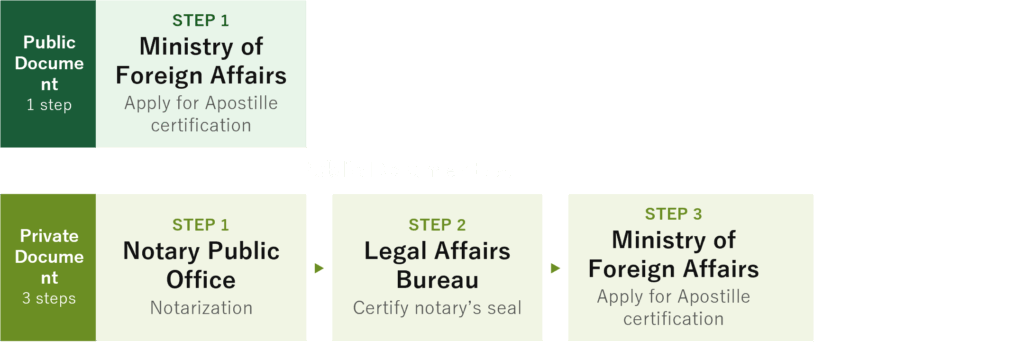
The required procedure differs depending on the type of document. For public documents, the procedure is completed simply by applying for Apostille certification at the Ministry of Foreign Affairs. For private documents, on the other hand, 3 steps are required: notarization at a Notary Public Office, certification of the notary’s seal at a Legal Affairs Bureau, and Apostille certification at the Ministry of Foreign Affairs.
<Process for Obtaining Apostille Certification>
⚡ One-Stop Service
This service allows all the steps at the Notary Public Office, Legal Affairs Bureau, and Ministry of Foreign Affairs to be completed together at 1 Notary Public Office. Using this service can significantly reduce the time required.
Currently, the regions where the One-Stop Service is available are as follows (as of September 2026)
Hokkaido (within the jurisdiction of the Sapporo Legal Affairs Bureau), Miyagi Prefecture, Tokyo, Kanagawa Prefecture, Shizuoka Prefecture, Aichi Prefecture, Osaka Prefecture, and Fukuoka Prefecture
※ For the most up-to-date list of covered regions, please refer to the Ministry of Foreign Affairs website listed at the end of this guide.
3.2 Required Documents and Fees
The documents and fees required for Apostille certification differ between public and private documents. The main details are as follows.
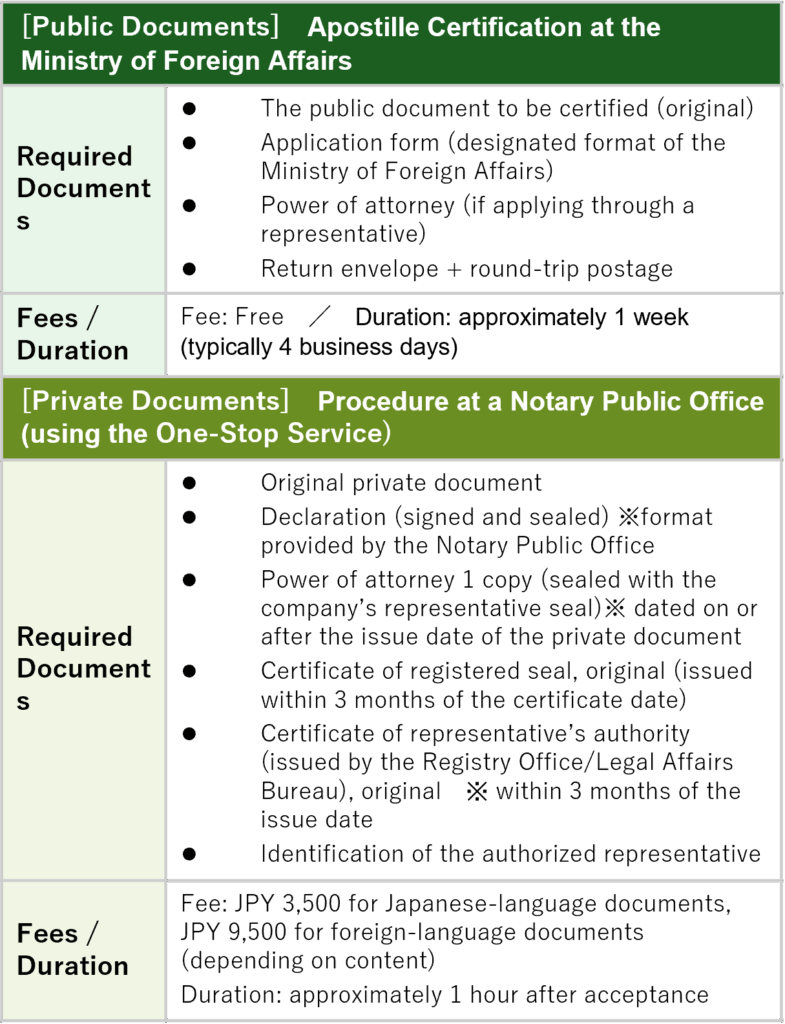
Apostille certification does not certify the translation of a document. Accordingly, whether a Vietnamese translation is required and the method of notarizing any required translation should be confirmed separately with the receiving authority. In addition, after Apostille certification has been obtained, visiting the Vietnamese Embassy or Consulate in Japan solely for translation purposes is not, in principle, expected to be available. For translation into Vietnamese, it will be necessary to arrange translation in-house or through a translation service provider.
4. Frequently Asked Questions
Q:What does it mean to convert a public document into a private document, and what are the benefits?
A:When obtaining Apostille certification at the Ministry of Foreign Affairs, applying by mail requires additional days for sending and returning the documents, which extends the time needed to complete the procedure.
On the other hand, if there is no time to visit the Ministry of Foreign Affairs counter in person, it is possible to attach a declaration to the public document and have it notarized as a private document. With this method, using a Notary Public Office that offers the One-Stop Service allows the procedures required at the Notary Public Office, Legal Affairs Bureau, and Ministry of Foreign Affairs to be completed together. This makes it possible to process multiple documents through the same procedure, and in the fastest case, complete everything within 1 day.
※Apostille certification itself at the Ministry of Foreign Affairs is free of charge. However, if a declaration is attached to a public document and notarized as a private document, a Notary Public Office fee will apply, the same as for private documents.
Q:What are common mistakes when preparing documents?
A1:Since documents are prepared in the order of original → declaration → power of attorney, be careful to date the declaration and power of attorney on or after the issue or acquisition date of the original notarized document. If the declaration is dated earlier than the issue date of the original, it will be considered inconsistent and invalid. If in doubt, it is safest to leave the date blank and fill it in in front of the notary at the time of notarization.
A2:For public documents issued by Japanese government agencies, the integrity of the document must be maintained before applying for Apostille certification at STEP 1 of the process described above. Be careful not to remove staples from the original, open the envelope of a certificate of no criminal record, or mark the document with a highlighter. If the document’s integrity is compromised, it may be considered invalid and require reissuance.
References
Ministry of Foreign Affairs of Japan
・Procedures for certifying official seals::https://www.mofa.go.jp/mofaj/toko/page22_000548.html
・One-Stop Service:https://www.mofa.go.jp/mofaj/toko/page22_000607.html
Embassy of Vietnam
Notice on the Application of Apostille Certification in Place of Consular Legalization:https://vnembassy-jp.org/ja/
Related Legislation
Decree No. 293/2026/ND-CP (effective September 11, 2026)
Related Reports
・Amendments to Decree 219/2025/ND-CP Concerning the Procedures for Issuing Work Permits to Foreign Workers