
The points to note regarding the recording of provisions for doubtful debts
2026/11/04
- I-GLOCAL.CO.,LTD. Hanoi Office
- Nguyen Vuong Thanh
Executive Summary
① Applicable rules and key point — From January 1, 2026, Circular 99/2025/TT-BTC governs the accounting treatment, while Circular 48/2019/TT-BTC sets the requirements for CIT deductibility. Receivables that are difficult to collect must be provided for, but provisions or their deduction are sometimes denied because of documentation deficiencies.
② Eligible receivables and provision rates — These are overdue receivables (measured from the original due date, excluding any agreed extension), BCC receivables, and receivables not yet due but with objective evidence such as bankruptcy or absconding. For general companies, the rate ranges from 30% (overdue 6 months to under 1 year) to 100% (3 years or more); for telecommunications and installment sales with individual debtors, the bands run from 3 to 12 months or more.
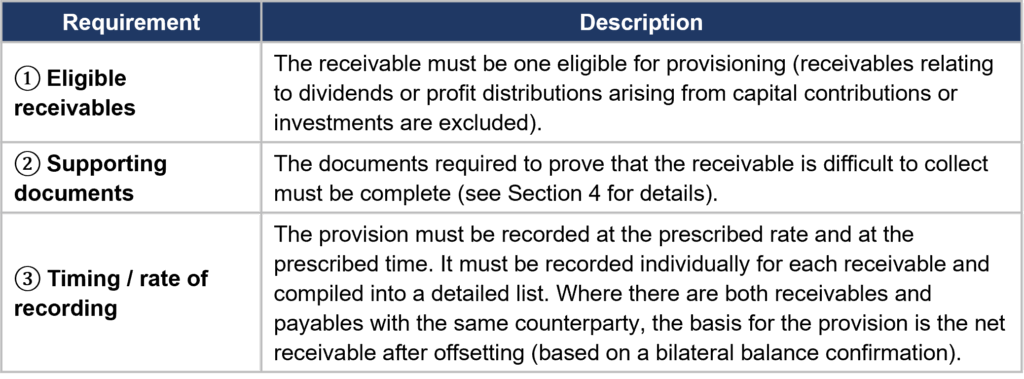
③ Three requirements for CIT deductibility — The receivable must be eligible (receivables relating to dividends or profit distributions are excluded), the documents proving collection difficulty must be complete, and the provision must be recorded at the prescribed rate and time, individually per receivable and compiled into a detailed list. Where the same counterparty has both receivables and payables, the net amount after offsetting is the basis.
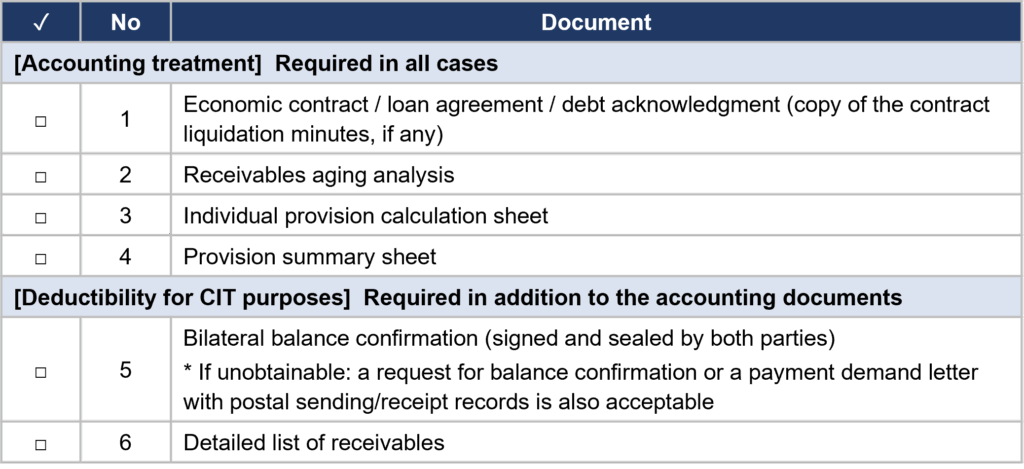
④ Required documents — For accounting: the contract, a receivables aging analysis, an individual provision calculation sheet, and a provision summary sheet. For CIT deductibility, a bilateral balance confirmation signed by both parties (or, if unobtainable, a confirmation request or payment demand with postal records) and a detailed list of receivables are also needed.
⑤ Handling uncollectible receivables — A receivable is deemed uncollectible on bankruptcy, dissolution or similar events, or if still uncollected 3 years after a 100% provision (1 year for telecommunications and similar cases with individual debtors). The provision is utilized against the loss, and write-offs are decided by the authorized person based on committee minutes. Written-off receivables must be tracked in the books for at least 10 years, with any recovery recorded as other income.
Introduction
In Vietnam, for receivables that are expected to be difficult to collect, a company must record a provision for doubtful debts and appropriately recognize the loss. On the other hand, it should be noted that, in order to treat this provision appropriately for both accounting and corporate income tax (CIT) purposes, sufficient supporting documentation must be prepared in addition to satisfying the relevant regulations. In practice in particular, there are cases in which the recording of the provision or its deduction for CIT purposes is denied due to deficiencies in documentary requirements. Based on these regulations, this report organizes the concepts and points to note regarding the recording of provisions for doubtful debts.
Note that from January 1, 2026, the accounting provisions have been updated by Circular 99/2025/TT-BTC (hereinafter “Circular 99”), while Circular 48/2019/TT-BTC (hereinafter “Circular 48”) applies to the requirements for deductibility for CIT purposes.
1.Definition of doubtful receivables
Under Circular 99, at the closing date a company must assess its trade receivables and other receivables and record a provision for doubtful debts for receivables showing indications of being difficult to collect.
・Overdue receivables: receivables that remain uncollected even though the payment due date set out in an economic contract, loan agreement, debt acknowledgment, etc. has passed. The overdue period is measured from the original payment due date stated in the original contract and does not include any payment extension period agreed between the parties.
・BCC receivables: receivables arising under a BCC (business cooperation contract, with no legal entity) for which there is a risk of non-collection because the project has been suspended or cannot be continued.
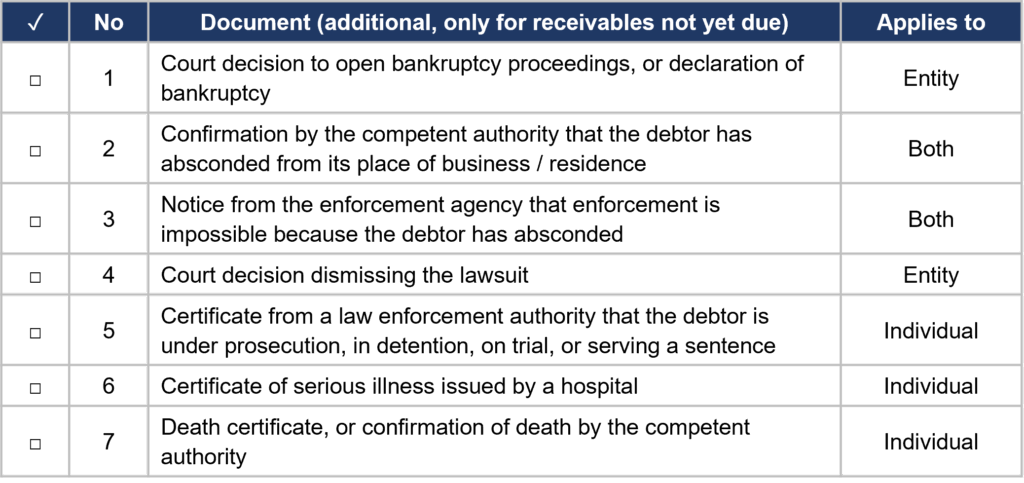
・Receivables not yet due but with objective evidence: receivables that have not yet fallen due but for which there is objective evidence indicating non-collectability, such as the debtor’s bankruptcy, dissolution, disappearance, or absconding.
2. Provision rates by overdue period
Under Circular 48 and Circular 99, the provision rates according to the overdue period are as shown in the table below.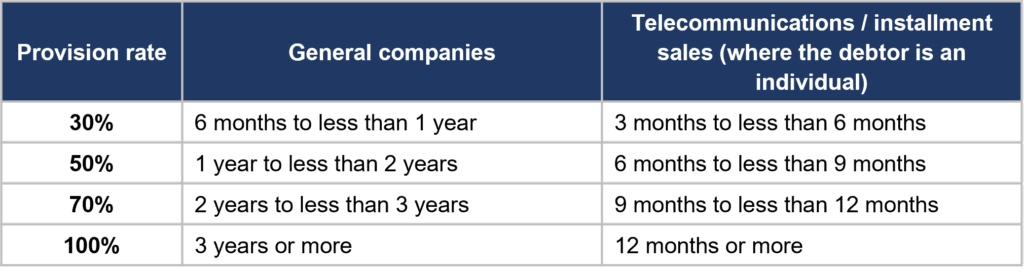
Even for receivables that have not yet fallen due, where there is objective evidence such as bankruptcy, dissolution, absconding, disappearance, being under prosecution, serving a sentence, or serious illness, the company reasonably estimates the loss amount and records it, up to the book balance.
* Circular 99 permits the use of another method if there is a highly reliable method for determining the recoverable amount. However, to be deductible for CIT purposes, the requirements of Circular 48 (see Section 3) must still be met.
* Provisions are recorded and reversed at the time the financial statements are prepared.
3. Requirements for deductibility for CIT purposes
Under Circular 48, for the provision charge for doubtful debts to be deductible in calculating CIT, all of the following three requirements must be met.
4. Documents required when recording the provision
When recording a provision for doubtful debts, preparing the required documents is a precondition. The main documents to be checked in practice are organized below as a checklist.
Additional documents for receivables not yet due
5. Actions after determining a receivable to be uncollectible
5-1 Criteria for determining uncollectibility
Regardless of whether the receivable has fallen due, it is determined to be uncollectible if any of the following applies.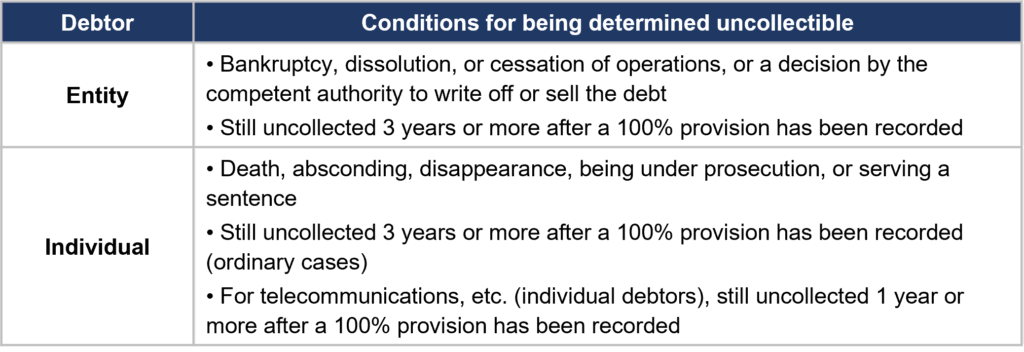
5-2 Procedure for loss treatment
・The provision already recorded is utilized and transferred to the loss; any shortfall may be deducted for CIT purposes, provided that the document requirements in Sections 5.3 and 5.4 are satisfied.
・The write-off of the receivable is decided by the authorized person on the basis of minutes and documents.
・Receivables written off must continue to be tracked in the books for at least 10 years, and collection efforts must continue. If collected, the amount is recorded as “other income.”
5-3 Supporting documents for loss treatment
* In addition to the full set of documents prescribed in Section 4, the following documents are required according to the type of debtor (entity or individual).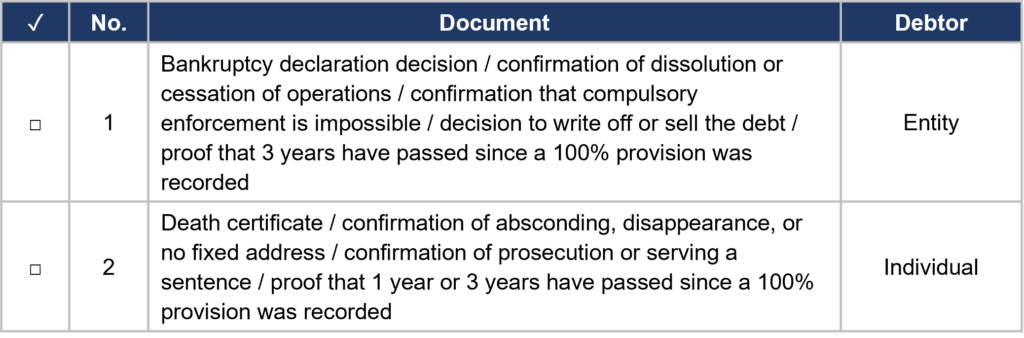
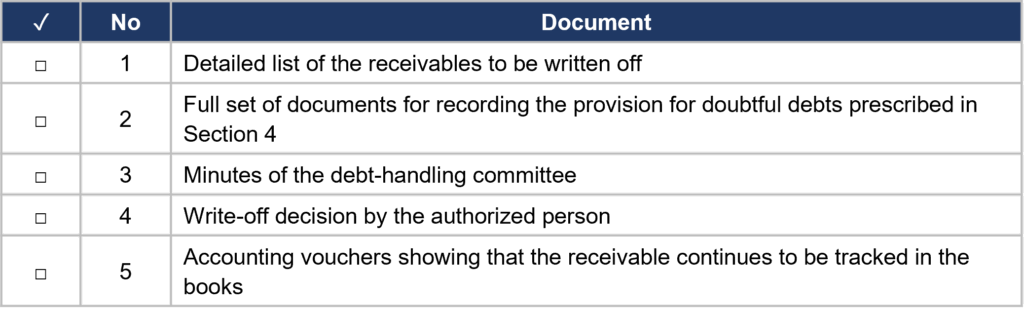
5-4 Documents for processing the write-off
Conclusion
The risk that trade receivables cannot be collected is one of the management issues that no company can avoid. Although recording a provision for doubtful debts is permitted under the system, in practice preparing supporting documents is essential, in addition to satisfying the requirements. In particular, since deficiencies in documents affect deductibility for CIT purposes, it is important to prepare in tandem with day-to-day receivables management. In light of this report, early and continuous action is recommended.
References
・Circular 99/2025/TT-BTC
・Circular 48/2019/TT-BTC
Related Report
・Tax Requirements and Key Points for Debt Offsetting in Vietnam
・Accounting treatment and internal management responses concerning Circular 99/2025/TT-BTC, applicable from January 1, 2026