
Overview of Personal Income Tax in Vietnam
2026/08/10
- I-GLOCAL.CO.,LTD Ho Chi Minh City Office
- Yuya Taniguchi
Executive Summary
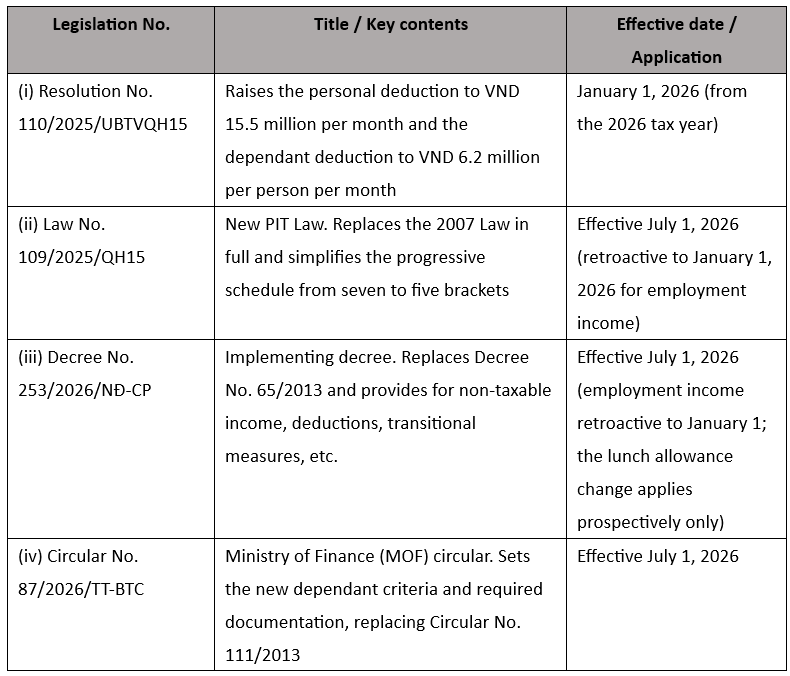
(i) Overview — Vietnam’s personal income tax underwent major reform across 2025-2026 through the new PIT Law (No. 109/2025/QH15), the deduction resolution (No. 110/2025/UBTVQH15), the implementing decree (No. 253/2026/ND-CP) and the circular (No. 87/2026/TT-BTC), fundamentally reshaping the system.
(ii) Key changes — The progressive schedule was simplified from seven to five brackets (top rate of 35% above VND 100 million per month); the personal deduction rises to VND 15.5 million and the dependant deduction to VND 6.2 million per person per month. Overtime and night-shift pay and severance payments (including amounts above the statutory level) become fully exempt, and the lunch allowance ceiling rises to VND 1.2 million per month.
(iii) Timing and transition — The legislation took effect on July 1, 2026, applying retroactively to employment income from January 1, 2026. Returns already filed for January to June 2026 under the previous rules need not be amended; any differences are settled in the 2026 annual finalisation.
(iv) Capital gains and practical response — Transfers of unlisted shares remain taxed at 0.1% of the transfer price, whereas transfers of LLC capital contributions by non-residents change from 0.1% of the transfer price to 20% of the gain. Companies should systematically review payroll calculations and prepare for adjustments at finalisation.
Introduction
Personal income tax (PIT) in Vietnam is levied on individuals who work in Vietnam, and it differs in important respects from the Japanese income tax system. For expatriates in particular, the scope of taxable income, the tax rates and the filing and payment rules are complex, so a proper understanding and appropriate planning are essential. This article sets out the basics of Vietnamese PIT and reviews the associated tax risks systematically. Vietnam carried out a major reform of its personal income tax in 2025 and 2026, reshaping the framework of the system. The reform responds to the sustained rise in prices and living costs and to the changes in the economic environment since the previous revision in 2020, and it aims to support consumption by rebalancing the tax burden and increasing the spending power of middle-income earners. This article reflects the rules as amended.
[Principal PIT-Related Legislation, 2025–2026]
1. Overview of Personal Income Tax
1-1 Determining resident and non-resident status
Under the tax law, and irrespective of the length of stay, a tax liability arises if an individual performs work in Vietnam on a business trip for even a single day. The method of calculating the tax and the applicable rates differ between Vietnamese tax residents and non-residents, as set out below.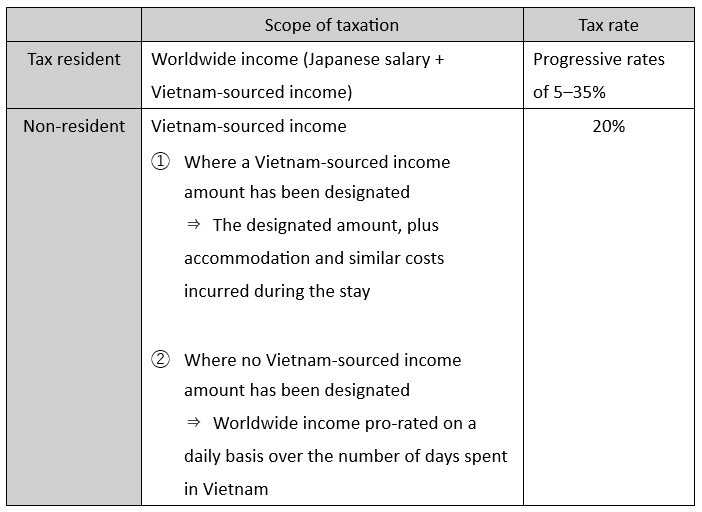
For this purpose, a tax resident is an individual who falls under any one of the following.
・Present in Vietnam for 183 days or more in a calendar year (January 1 to December 31)
・Present in Vietnam for 183 days or more within the 12 months from the date of first entry into Vietnam
・Holding a lease with a term of 183 days or more within the tax year (however, an individual who holds a certificate of residence issued by a tax authority outside Vietnam is treated as a non-resident)
A common misconception is that holding a visa or work permit affects residency status, but it has no bearing on the test; residency is determined solely by whether any of the three conditions above is met.
A flowchart for determining residency is set out below. One point to note is that, although the legislation contains no such rule, in practice an individual who holds a temporary residence card (TRC) may be treated as having a lease and therefore as a tax resident. Accordingly, where an individual holds a TRC but will stay for fewer than 183 days, we recommend obtaining a certificate of residence from the tax authority in the home country (*).
* For details of how to obtain one, please refer to the Japanese National Tax Agency website below.
https://www.nta.go.jp/taxes/shiraberu/taxanswer/osirase/9210.htm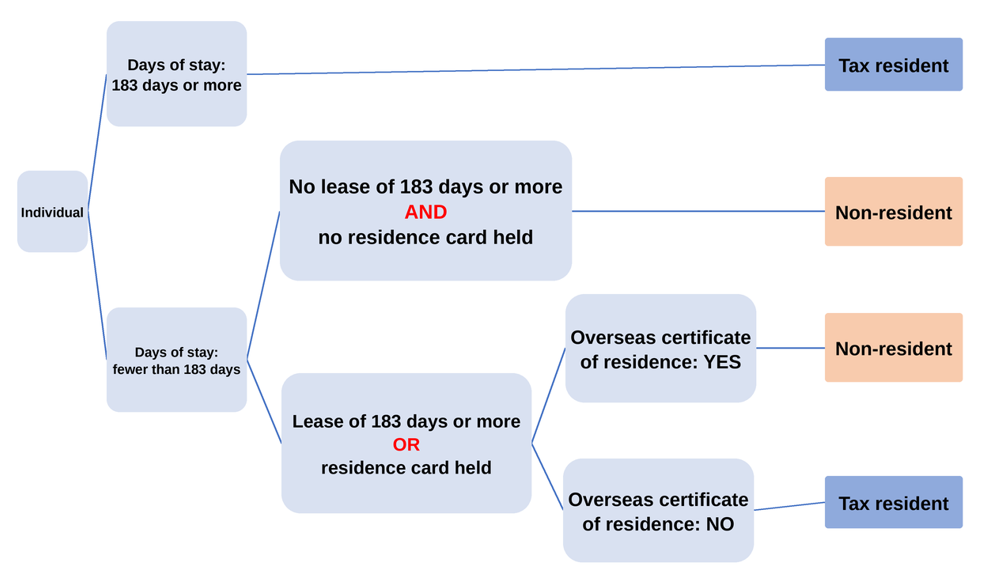
Article 4 of Decree No. 253 also codifies how days of presence are counted. The date of arrival and the date of departure each count as one day, and where an individual arrives and departs on the same day, the two together count as one day. Arrival and departure dates are determined from the endorsements made by the immigration authorities in the passport or equivalent document.
1-2 Tax rates
Vietnamese tax residents are subject to progressive rates ranging from 5% to 35%. The rates themselves are low compared with those in Japan, but Japan’s top rate of 55% (45% income tax plus 10% resident tax) applies only from a monthly salary of roughly JPY 3.5 million and therefore reaches only a narrow band of taxpayers. In addition, because expatriates in Vietnam have a broad taxable income base, many are taxed at 30% or 35%, so their overall tax burden is often heavier than it would be while working in Japan.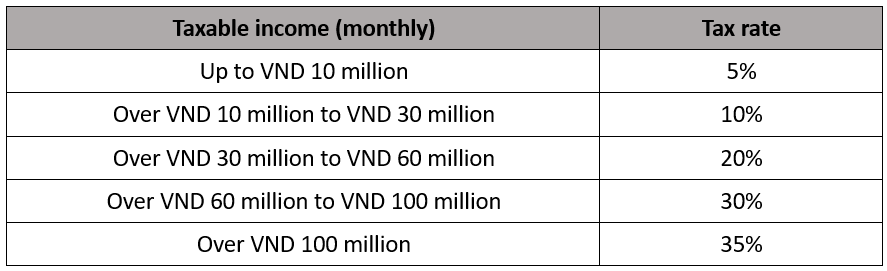
Low- and middle-income earners (monthly income below VND 100 million) see an effective reduction in tax through the simplified bracket structure and the higher deduction amounts. For the high-income band into which most Japanese expatriates fall, however, the top rate of 35% is retained, so the benefit is limited and the impact on overall expatriate costs is expected to be small. Note that the effect on Vietnamese staff in the middle-income band is comparatively greater, and companies should also be mindful of the indirect implications for salary reviews and for recruitment and retention.
In addition, in order to avoid a reduction in take-home pay caused by the difference in tax rates between Vietnam and the home country, companies frequently bear the PIT themselves and adjust the package so that net pay matches the amount the employee would receive in Japan (a net-guarantee arrangement). In practice almost all Japanese expatriates are handled in this way; once non-taxable benefits are also taken into account, the annual cost per expatriate needs to be budgeted at roughly 2.5 times the individual’s annual salary while working in Japan.
1-3 Filing and payment procedures
Filing and payment follow the schedule below. Monthly filing and payment apply where the Vietnamese entity paying the salary files and pays VAT on a monthly basis (see Note); in all other cases, and for amounts paid by a foreign entity, filing and payment are made quarterly.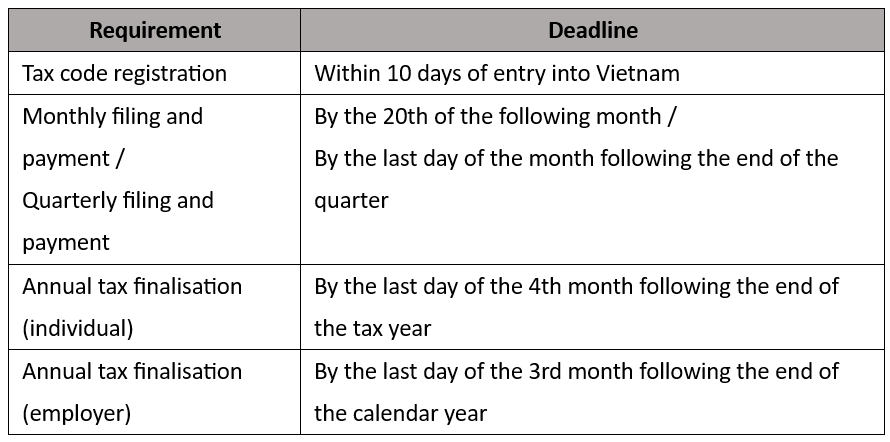 (Note) Monthly VAT filing and payment applies to entities that have been in operation for a full 12 consecutive months or more and whose revenue in the preceding year exceeded VND 50 billion.
1-4 Taxable income and deductible items
The scope of taxable employment income is wide-ranging, since allowances, fringe benefits and company-borne costs paid for the benefit of the individual are in principle also treated as taxable. Representative items include the following.
・Housing costs
・Health check-ups and comprehensive medical examinations (non-taxable where provided to all employees)
・Assignment allowances and relocation allowances (on initial assignment, the portion attributable to the employee personally, as opposed to accompanying family, is non-taxable)
・Airfare for home leave (the employee’s own ticket, once a year, is non-taxable)
・Golf fees and golf club membership costs
・Fees paid to an accounting firm for preparing tax returns
・Payments made to a child’s school other than tuition fees
For housing costs, where the company contracts directly with an apartment or hotel and pays the related costs, the amount added to taxable income is the lower of the “actual housing cost borne by the company” and “15% of taxable income excluding housing costs”. An illustrative calculation is set out below.
(Example) Monthly salary of USD 10,000 and monthly rent of USD 2,000 (borne by the company)
15% of salary = USD 1,500 < rent of USD 2,000, so taxable income in this case is
10,000 + 1,500 = USD 11,500.
The following items are also deductible for tax purposes.
1.Employee contributions to compulsory social insurance, health insurance and unemployment insurance
2.Personal deduction: VND 15.5 million per month
・Dependant deduction: VND 6.2 million per dependant per month
The premiums under (i) also include contributions to Japanese social insurance where the individual remains enrolled in the Japanese scheme. Under Decree No. 253, the documentary requirements for the insurance deduction have been tightened: previously either a copy of the payment document issued by the insurance organisation or a confirmation from the income payer of the amount withheld and remitted was sufficient, whereas both documents are now required. As regards the dependant deduction under (iii), a spouse is eligible under the legislation, but only where the spouse is over retirement age or has a disability; in practice, where expatriates in Vietnam claim the dependant deduction, it is almost always claimed for children under 18. The dependant rules have also been clarified in this reform: “other dependants” (siblings, grandparents, etc.) must live with and be directly supported by the taxpayer, and “incapable of work” is now defined quantitatively as a working-capacity reduction of 81% or more, evidenced by certification issued by a medical institution.
Decree No. 253, promulgated on June 30, 2026 and effective from July 1, 2026, finalises the scope of non-taxable income and deductions. The changes with the greatest impact on Japanese companies are summarised below in before-and-after form.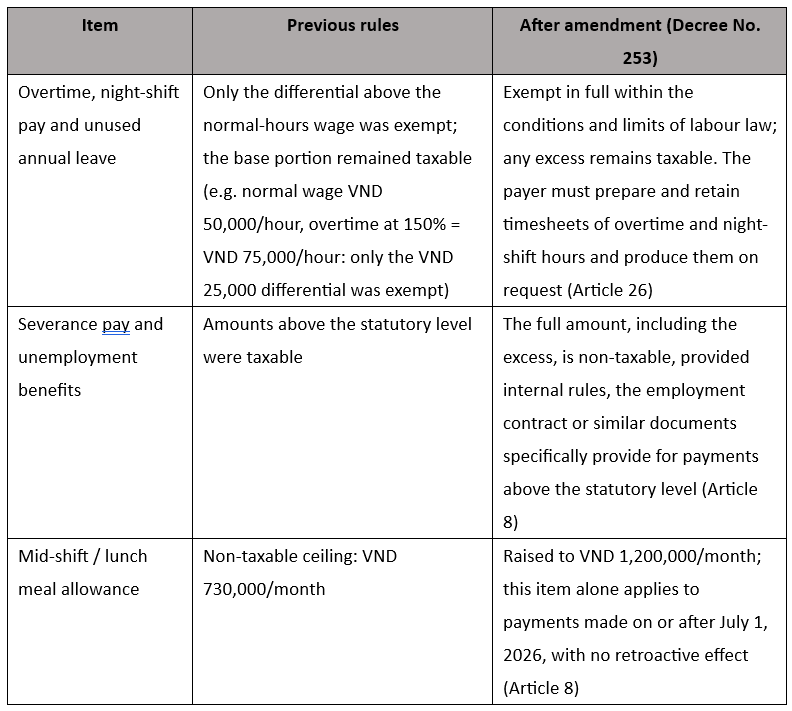
In addition, Decree No. 253 and related instruments expand tax exemptions for high-tech and similar personnel and consolidate the exemption rules for transfers, inheritances and gifts of real estate.
Transitional measures are also provided for the changeover: because the new rates and deduction amounts apply retroactively to the 2026 tax year (from January 1) while the Decree itself took effect on July 1,2026, withholding and filings for January to June 2026 were made under the previous rules. Monthly or quarterly returns already filed for that period need not be amended; any over- or under-payment arising from the difference between the old and new rules is settled together in the 2026 annual finalisation.
1-5 Update on capital gains taxation
The overall framework of capital gains taxation remains unchanged from the previous law; the key point is that unlisted shares, for which gain-based taxation had been considered in the draft, remain taxed at 0.1% of the transfer price. As the treatment under the former circular has been maintained, individuals connected with Japanese companies (directors, secondees, etc.) who hold unlisted shares face no increase in tax burden as a result of the reform.
By contrast, for capital contributions in limited liability companies, the calculation method for non-residents has changed from 0.1% of the transfer price to 20% of the gain. Because this is a substantive change and the tax burden may increase or decrease depending on the actual profit margin of the transaction, we recommend a specific calculation before executing a transfer.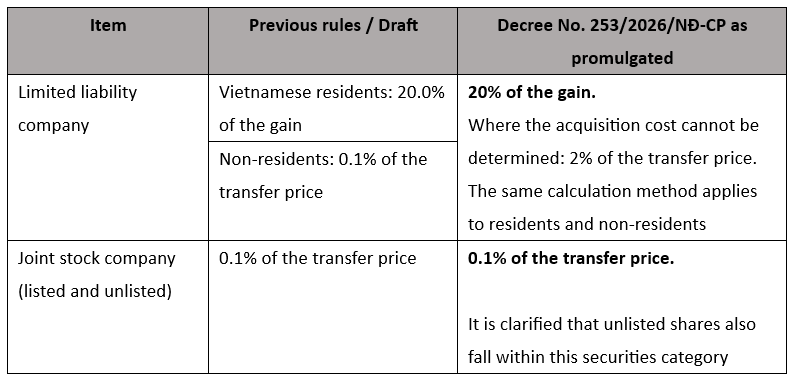
2.Key PIT considerations for expatriates
2-1 Tax year and filing patterns in the first year of assignment
As a rule, the tax year is the calendar year (January 1 to December 31). However, if the individual is present for fewer than 183 days in the calendar year of their first year of assignment, the first tax period is the 12 consecutive months from the date of entry, and the second tax period is the calendar year.
Examples of filing patterns for the first year of assignment are set out below. Assuming a first entry date of February 1, 2025 on a pre-assignment business trip and an assignment date of June 10, 2025 (taken here to be the same as the actual date of entry), the filing patterns are as follows.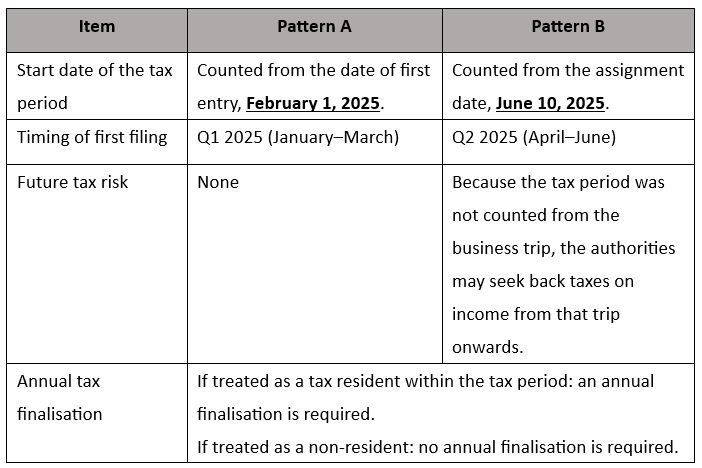
In practice, the timing of the first filing is most commonly counted from the work commencement date stated in the letter of assignment.
While the definition of the date of first entry is not clear as a matter of law, where the individual has visited Vietnam on business trips before the formal assignment, the authorities may require the count to begin from the date of entry on that business trip, based on the entry and exit record in the passport. Accordingly, where an individual travels to Vietnam on a business trip before the formal assignment – for example, to prepare for the establishment of a company – we recommend conservatively treating the date of entry on that first business trip as the date of first entry (Pattern A above).
2-2 Risk of assessment on a tax audit
Additional assessments arising from tax audits are as set out below. As a rule, issues are not raised each time a tax return is filed; in most cases they are raised in the tax audit conducted every three to five years. Because expatriate salaries are high, this is one of the items most likely to be targeted, and care should be taken accordingly.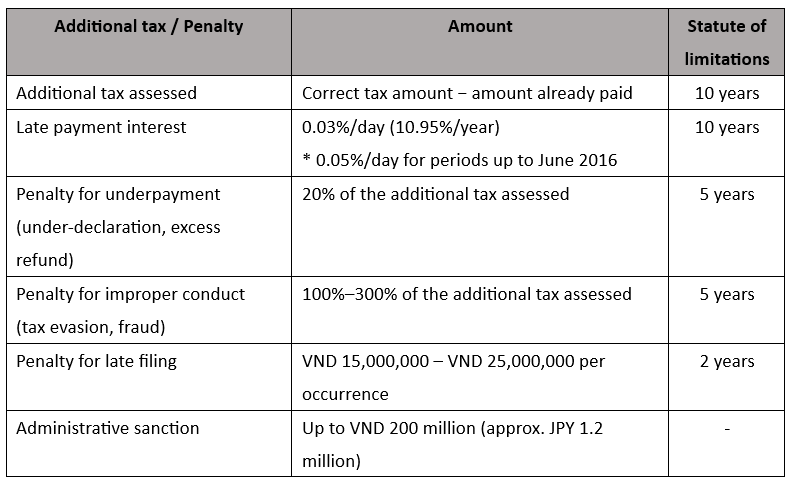
The risks most commonly raised on a tax audit are summarised below in general terms. The calculations involved are complex and errors are easy to make, so we recommend that the work be handled by experienced practitioners wherever possible.
(1) Tax risks relating to expenses and allowances
・VAT invoices: Where a VAT invoice is missing or defective, there is a high risk that the cost will be regarded as unrelated to the business and treated as a benefit to the individual. There have been cases in which entertainment and travel expenses advanced by an expatriate were taxed as that individual’s income because of defects in the invoice, and were also disallowed as a deductible expense at the corporate level.
・Clear internal regulations: Allowances and fringe benefits are ordinarily outside the scope of PIT, but where they are not set out in the company’s financial regulations or in the employment contract, there is a risk that they will be regarded as a benefit to the individual and treated as taxable.
(2) Tax risks for non-residents
・Short-stay exemption (183-day rule) claims: A non-resident may claim exemption under the Japan–Vietnam tax treaty where certain conditions are met. Until several years ago approval was sometimes obtained, but the tax authorities’ view on permanent establishments has shifted in recent years and applications now tend to be rejected. Even where the exemption conditions appear to be satisfied, we recommend filing and paying tax on Vietnam-sourced income in order to avoid additional assessments and late payment interest.
・Non-resident legal representatives (visiting on business trips): Legal representatives tend to be scrutinised more closely than other expatriates. Depending on the tax authority’s view, there is a risk of a challenge on the basis that the representative should receive a salary even when they are not physically present in Vietnam, so we recommend setting a Vietnam-sourced income amount. Please also be mindful of whether that amount is reasonable: if it is lower than “worldwide income apportioned over the number of days spent in Vietnam”, there is a risk that it will be regarded as unreasonable.
Conclusion
Vietnam’s PIT system differs from Japan’s, and careful management is required for expatriates and business travellers. Because the amounts at stake in a tax audit can be significant, it is essential to understand the risks and to ensure accurate filing and payment. The current reform extends to tax brackets, deduction amounts and the scope of non-taxable income. As most of the changes apply retroactively to the 2026 tax year, companies should plan a systematic review of payroll calculations and prepare the adjustments needed ahead of the annual finalisation.
Related Reports
・Points to note regarding foreign tax credits for Personal Income Tax (PIT)