
Key Considerations on Employers' Withholding and Deduction of Wage Payments
2026/04/22
- I-GLOCAL.CO.,LTD Ho Chi Minh City Office
- Ho Thi Y Nhi
Executive Summary
Vietnamese labor law imposes a strict obligation on employers to pay wages “directly, in full, and on time.” While withholding or deducting wages may be considered in disciplinary or termination-related scenarios, the legally permissible scope is extremely limited.
Key Points
・[Withholding] Generally prohibited. An exception allows delays of up to 30 days only in cases of force majeure, but the absence of a clear legal definition of “force majeure” creates significant legal risk.
・[Deduction] Permitted only for compensation of minor damages caused by employee negligence. Monthly deductions are capped at 30% of net wages (after social insurance and personal income tax), and total damages must not exceed 10 months of the applicable regional minimum wage.
・[Penalties for Violations] Unlawful withholding or deduction may result in administrative fines of VND 10 million–100 million, plus an order to pay the full outstanding amount with late interest. Monetary penalties used as a substitute for disciplinary action are subject to fines of VND 40 million–80 million.
・[Practical Risk] Non-compliance exposes employers to labor disputes and reputational damage. Employers must verify the permissible scope before taking any withholding or deduction action.
Introduction
The payment of wages is one of the fundamental obligations of employers and, at the same time, an important right of employees. In practice, employers may consider withholding wage payments for a certain period or deducting a certain amount in situations such as disciplinary actions or the settlement of accounts upon termination of an employment contract. However, withholding wages is not permitted as a general rule, and deductions may not be implemented unless specific statutory conditions are met. This report explains the key considerations regarding the withholding and deduction of wage payments.
1. Legal Provisions on the Principle of Wage Payment to Employees
Under the 2019 Labor Code, wages are defined as monetary amounts paid by the employer to the employee in accordance with their agreement, including basic wages corresponding to the job or position, wage allowances, and other additional payments. Accordingly, employers are legally obligated to pay wages to employees directly, in full, and on time. This principle not only defines the employer’s fundamental legal obligation but also serves as an important standard in practice for assessing the lawfulness of any act of withholding or deducting wages.
2. Cases Where Employers Withhold or Deduct Wage Payments
2.1 Withholding of Wage Payments
Wage withholding refers to the act of an employer retaining all or part of wages that are otherwise due for payment without paying them. While no explicit provision has been established in the relevant legislation, based on the wage payment principles under the Labor Code outlined above, withholding is generally not a permissible act. On the other hand, with respect to delayed payment of wages, there is a provision that exceptionally permits delay (not exceeding 30 days) only in cases where the employer is unable to pay wages on time due to force majeure despite having taken all remedial measures. In practice, instances have been observed where employers attempt to use this exceptional provision on payment delays as a nominal basis for effectively withholding wages — despite having no legal grounds to do so.
However, as no clear definition has been established under the labor legislation for what constitutes “force majeure,” it is currently difficult to determine in which circumstances withholding may be permitted. Accordingly, where an employer seeks to withhold an employee’s wages using the delayed payment provision as a basis, it is necessary to carefully examine the legality of such action, and employers are required to exercise a high degree of caution to avoid exposure to legal risk.
2.2 Deduction of Wages
Wage deduction refers to the act of an employer withholding a portion of wages when making payment to an employee. Article 102 of the 2019 Labor Code permits wage deductions only in cases where an employee is liable for compensation for minor damage to company equipment or property caused by negligence, and the damage amount must not exceed ten months of the applicable regional minimum wage. Even in such cases, the employer must clearly notify the employee of the reason for the deduction, and the amount that may be deducted in any given month is capped at 30% of the employee’s actual net wages after statutory deductions for social insurance premiums and personal income tax.
By way of example, consider an employee working in Ho Chi Minh City whose actual net wages for the current month amount to VND 30,000,000 (the regional minimum wage in Ho Chi Minh City is VND 5,310,000 per month as of February 2026). The employee negligently damages a company-issued laptop, and the damage is assessed at VND 12,000,000. The damage is determined to constitute “minor damage” under the company’s internal work rules. In this case, the monthly deduction cap is 30% of the employee’s actual net wages (after social insurance premiums and personal income tax), meaning the maximum deductible amount for the current month is VND 9,000,000, and the remaining balance of VND 3,000,000 would be deducted in installments in subsequent months.
As described above, while wage deductions are permitted by law in certain limited circumstances, the scope of application is restricted to cases related to damage compensation, and the deductible amount is subject to a cap — in order to prevent employers from abusing the deduction mechanism and to protect the legitimate rights and interests of employees.
3. Unlawful Withholding and Deduction of Wages and Administrative Sanctions
In practice, instances of non-compliance with the legal provisions on wage withholding and deduction have been observed. Examples include cases where an employer withholds wage payment upon termination of an employment contract on the grounds that the employee has not yet completed the handover of duties, and cases where — in lieu of formal disciplinary procedures — monetary sanctions such as wage deductions or pay cuts are effectively imposed as a form of financial penalty for breaches of work discipline.
Where an employer acts in violation of the applicable laws in such a manner, multiple legal risks may arise. First, as administrative sanctions under labor law, the employer may be subject to administrative penalties. The specific details are set out in the table below.
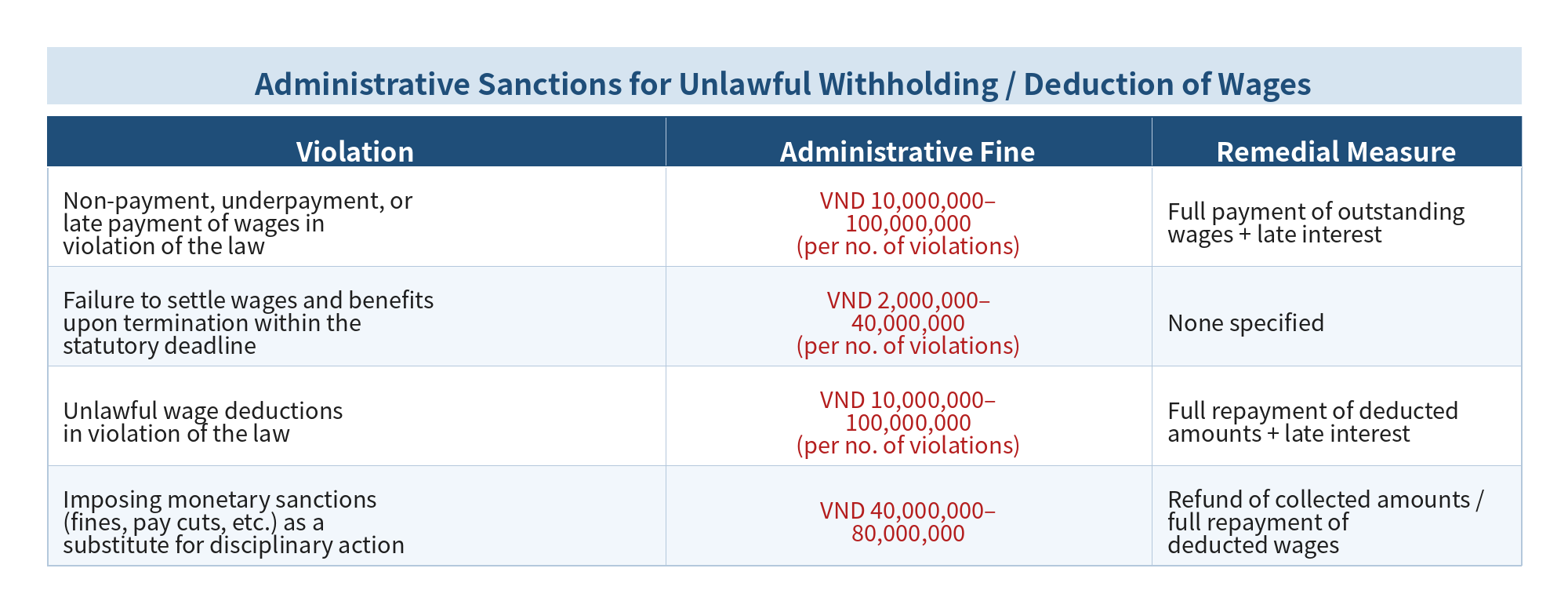
Furthermore, as violations relating to wages directly affect the rights and interests of employees, there is a risk that such conduct may escalate into a labor dispute. Where disputes are prolonged, they may not only adversely affect labor relations and the workplace environment, but may also damage the employer’s social credibility and corporate reputation. Accordingly, employers are required to handle such matters with great care.
Conclusion
While the withholding and deduction of wages by employers may be contemplated in practice, the scope of what is legally permissible under labor law is extremely limited. Where such actions are taken without a legal basis or in excess of the permissible scope, they may give rise to legal risks including administrative sanctions and labor disputes.
Therefore, where employers consider withholding or deducting wages in response to disciplinary matters or upon settlement at the time of resignation or termination, it is essential to accurately ascertain the permissible scope in order to ensure legal compliance and maintain stable labor relations.
References
・2019 Labor Code
・Decree No. 12/2022/ND-CP
Related Reports
・Key Considerations When an Employee Unilaterally Terminates a Labor Contract in Violation of the Law