
Liquidation Procedures for Vietnamese Companies –Overall Flow and Key Practical Considerations–
2026/08/25
- I-GLOCAL.CO.,LTD Hanoi Office
- CFE
- Kiriko Kashima
Executive Summary
①Path to considering liquidation: When continuation, resumption, or succession of the business is not realistic even after considering downsizing, dormancy, M&A, or business succession, liquidation ultimately becomes an option.
②Overall picture of the liquidation process: The process requires procedures across multiple areas — including termination of the investment project, tax audit and tax code closure, labor matters, and closure of bank accounts — and typically takes one to two years to complete. The tax audit in particular is a major factor affecting the timing of completion.
③Key tax and labor considerations: Financial statements and tax filings, VAT refunds, responding to tax audits, and notifying employees and settling their entitlements all require attention spanning the investment, tax, and labor fields.
④Early preparation is essential: It is important to organize the overall schedule and required actions — including securing accounting personnel, arranging space for document storage and tax audit support, and organizing bank accounts — before the liquidation decision is made, and to proceed with preparation in a planned manner.
Introduction
As business environments and group strategies change, it is not uncommon for companies to consider restructuring or withdrawing from overseas operations. In Vietnam as well, according to finalized full-year 2025 data from Vietnam’s General Statistics Office (GSO), approximately 76,900 companies were awaiting liquidation procedures during the year, and approximately 35,900 companies completed liquidation procedures (an increase of 66.1% year on year).
There are several ways for a company to withdraw from business, one of which is corporate liquidation. This paper first organizes the thinking process that leads a foreign-invested company (hereinafter, “FDI company”) to a decision to liquidate, and then explains the overall picture of the liquidation procedure and key practical considerations.
1. The Path to Liquidation
When a company reviews its Vietnam operations, various options are available, including continuing on a reduced scale, temporarily suspending business activities (“dormancy”), transferring shares/equity to a third party, transferring the business or assets, or succeeding the business and management resources through intragroup restructuring, among others.
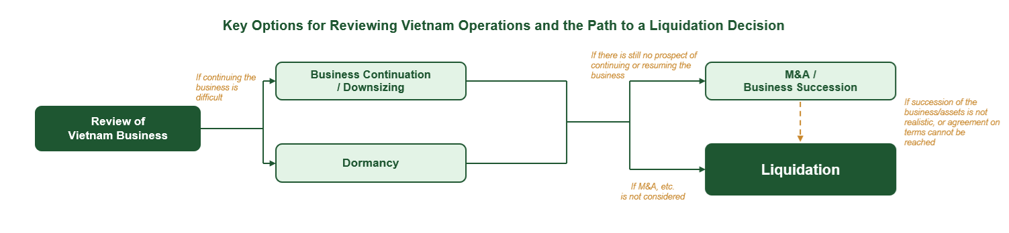
When continuing the business is difficult, downsizing or dormancy becomes the first option considered. If there is still no prospect of continuing or resuming the business, succession of the business and management resources through M&A or business succession, as shown in the diagram, also becomes an option. Where succession is not realistic given the state of the business or assets, or where agreement on terms cannot be reached even after considering M&A, liquidation — that is, terminating the corporate entity itself — is ultimately chosen.
On the other hand, liquidating an FDI company requires procedures across multiple fields, including investment, tax, and labor, and completion can take a long time. For this reason, it is important to understand the required time and cost from the stage at which liquidation is being considered as an option, and to proceed with preparation in a planned manner.
From the next chapter onward, this paper focuses on the corporate liquidation procedure* and explains the flow of the procedure and points to note.
*In this paper, the term “liquidation procedure” is used to collectively refer to the series of procedures under the Enterprise Law for “dissolution” and the associated settlement of assets and liabilities.
2.Overall Flow of the Liquidation Procedure
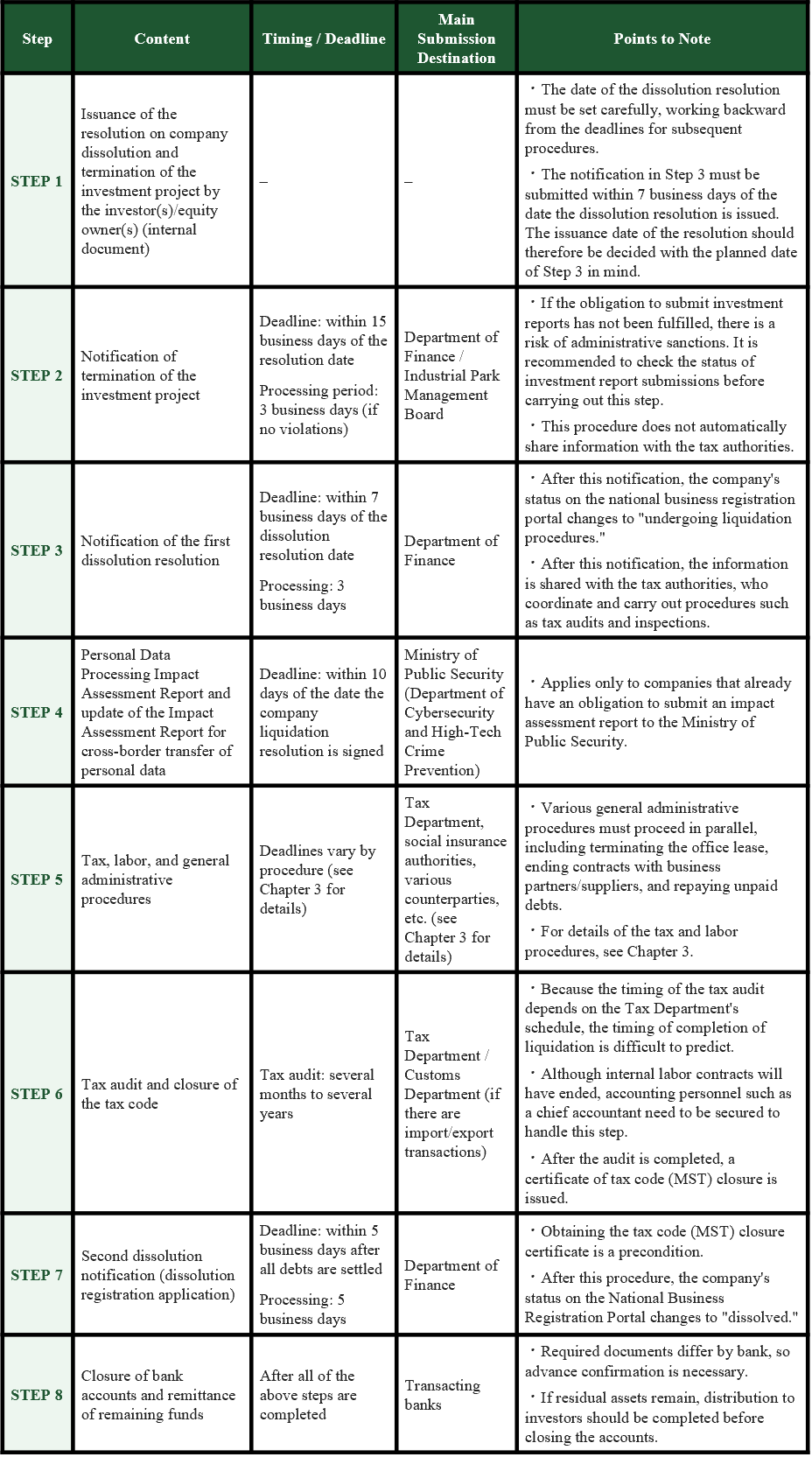
Liquidation broadly consists of eight steps, and Step 6 (the tax audit) in particular is the most time-consuming procedure. The liquidation flow described below applies where the company’s only base in Vietnam is the Vietnamese company itself.
〔What happens to representative offices or branches linked to the Vietnamese companies?〕
Where a Vietnamese company has dependent establishments such as representative offices, branches, or business locations, the law requires that the procedures to terminate the activities of such dependent establishments be carried out before filing the company’s liquidation application.
On the other hand, whether the procedures to terminate a dependent establishment’s activities can be carried out in parallel with the company’s liquidation procedures, and whether the company’s liquidation procedures can begin before termination of the dependent establishment’s activities is complete, is not clearly stipulated under the law and is open to interpretation.
Because this interpretation may affect how the overall liquidation procedure proceeds and how long it takes, it is advisable for companies with dependent establishments to check in advance with the competent tax authorities or Department of Finance before starting the liquidation procedure.
3.Treatment upon Company Liquidation – Tax and Labor
In the liquidation procedure, the tax and labor aspects are, in practice, the most complex and time-consuming.
The following sets out an overview of each procedure and the key points to note.
3-1 Tax
(1) Preparation and audit of financial statements
Final-period financial statements are prepared as of the dissolution resolution date. These financial statements are prepared in a special format that does not assume “going concern.” FDI companies are subject to mandatory statutory audit, and submission is required to the Department of Finance, the Tax Department, the Statistics Office, and the industrial park/export processing zone management board (if requested).
(2) Final-period VAT and PIT filings
VAT and PIT filings for the final tax period (monthly or quarterly, depending on the company) are submitted to the Tax Department. The filing deadline is the 20th of the following month for monthly filers, or the last day of the first month of the following quarter for quarterly filers. Any outstanding tax must be paid at the same time the filing is submitted.
(3) CIT and PIT finalization filings
Within 45 days of the liquidation resolution date, CIT and PIT finalization filing documents and tax payment certificates must be submitted to the Tax Department. Any outstanding tax must be paid together with the finalization filing. After the PIT finalization filing is completed, withholding tax certificates must be issued to employees.
(4) VAT refund
If uncredited input VAT remains at the time of the company’s liquidation, VAT refund can be claimed. However, because a tax audit will verify the details of the refund when VAT refund is claimed, the liquidation procedure may be prolonged. It is therefore important to consider the overall schedule in advance, including whether or not to pursue VAT refund.
〔When should VAT refund be carried out?〕
There are several cases under the VAT refund system, but the following two are, in practice, most commonly used by FDI companies considering liquidation.*
1. VAT refund related to export transactions
During normal business operations, refunds of “VAT related to export transactions” are made monthly/quarterly. If a company has exported goods/services during the relevant month/quarter and has uncredited input VAT of VND 300 million or more, it can receive a refund on a monthly/quarterly basis. On the other hand, “VAT related to domestic transactions” cannot be refunded while the company is operating, and is instead handled during the liquidation procedure described in item 2 below.
2. VAT refund at the time of liquidation
Refund can be claimed for overpaid tax or uncredited input VAT, including VAT that could not be refunded while the company was operating. If the tax audit associated with liquidation is prolonged, there is a risk that the VAT refund may not be received for several years. For this reason, where there is a balance of “VAT related to export transactions” to be refunded, it is important from a cash-flow perspective to complete the refund application as much as possible before entering the liquidation procedure.
*In addition to the above, there is also a refund system for new or expanded investment projects, but this relates to the investment phase of an operating company and is not normally relevant to a company in the liquidation phase, so it is omitted from this paper.
(5) Tax audit
After the liquidation notification reaches the finance authorities, the Tax Department decides to conduct a tax audit under its authority. The company should proactively contact the tax authorities to discuss a schedule that suits the company. FDI companies tend to be examined particularly strictly on matters such as transfer pricing and VAT. It is important to prepare the following documents in advance:
● Legal documents: IRC (Investment Registration Certificate), ERC (Enterprise Registration Certificate), etc.
● Accounting records: ledgers, vouchers, financial reports, audit reports
● Tax filing documents: a full set of documents (including filings, calculation statements, tax payment certificates, etc.) relating to each tax item arising at the company — VAT, CIT, PIT, foreign contractor tax, etc. — thoroughly prepared
● Transfer pricing documentation: transfer pricing documentation for the relevant years
● Other: employee-related documents, dependent deduction application documents, refund application documents (if any)
〔What points should be considered in practice?〕
Point 1: Securing accounting personnel!
During the liquidation procedure, employment contracts legally terminate, but support from a chief accountant or accounting staff who is familiar with the company’s situation continues to play an essential role during the tax audit process. In practice, the following approaches are sometimes taken:
● Enter into a service contract with accounting personnel to continue their cooperation until the tax audit is completed.
● Set a severance payment or special bonus above the statutory minimum as an incentive for continued cooperation.
● Negotiate terms with personnel the company wants to retain before the liquidation process begins.
Point 2: Securing space for document storage and tax audit support!
During the liquidation procedure, the office lease will be terminated before the procedure is completed, but space is needed at the time of the tax audit. In practice, the following approaches are sometimes taken:
● Secure a place to store documents until the tax audit is completed, such as a monthly-rental storage unit or a small office.
● On the day of the tax audit, the authorities visit to review the books, so a meeting room, etc. is needed. Renting a serviced or shared office on a monthly basis, used only for the necessary period, is cost-effective.
Point 3: Organize bank accounts in advance!
Even after the company liquidation procedure begins, bank accounts are, in principle, not frozen, and deposits and withdrawals remain possible. However, if new transactions occur during the liquidation period, the tax authorities may ask for confirmation of the details, which can lead to a prolonged tax audit or liquidation procedure. For this reason, it is advisable to complete necessary fund arrangements — such as terminating time deposits — before the liquidation procedure begins, and to keep transactions during the liquidation period to a minimum.
(6) Customs procedures (where there is import/export activity)
Where a company has import/export activity, a final settlement report on raw materials, machinery, etc. must be submitted to the customs authorities; this can be carried out in parallel with the tax audit. Please check with the competent customs department for details.
3-2 Labor
(1) Termination of labor contracts
Under the Enterprise Law, the company must notify employees of the company’s dissolution within 7 business days of the date the dissolution resolution is issued. In addition, under the Labor Code, when a company is liquidated, labor contracts are deemed terminated at the point the company notifies employees of the termination of its operations.
In practice, however, it is common for the company to notify employees before the point of liquidation and terminate labor contracts by agreement with employees. In this case, because the termination is by mutual agreement, the statutory notice-period requirements for dismissal under the Labor Code do not need to be applied.
(2) Return of work permits and residence cards for foreign employees
 (3) Settlement of employee entitlements
The following must be paid within 30 days of the termination of the labor contract:
● Unpaid salary, bonuses, and various allowances
● Payment in lieu of unused annual paid leave
● Severance pay (for employees with 12 months or more of service: 0.5 months’ pay per year of service)
*Regarding the period counted for calculating severance pay, probationary periods, sick leave, maternity leave, etc. are included. Periods of unemployment insurance coverage, and periods of prior service for which an amount equivalent to unemployment insurance was received, are excluded from the calculation.
(4) Social insurance procedures
A “report of decrease in the number of employees” must be submitted to the social insurance authority in the month the labor contract terminates. The social insurance book must be closed within 30 days of the labor contract termination date and returned to the employee.
〔What is the mandatory insurance refund procedure for foreign employee?〕
Foreign employees who have been enrolled in Vietnam’s mandatory insurance system can, upon meeting certain requirements such as termination of the labor contract, receive a lump-sum social insurance payment upon their own application. The refund application is submitted directly to the social insurance authority by the individual after leaving the company; the company is required to close and return the social insurance book and issue documents certifying termination (such as a labor contract termination confirmation). For details of the procedure, please refer to the following report:
https://www.i-glocal.com/report/260316/
4.Summary: Points for Management to Keep in Mind
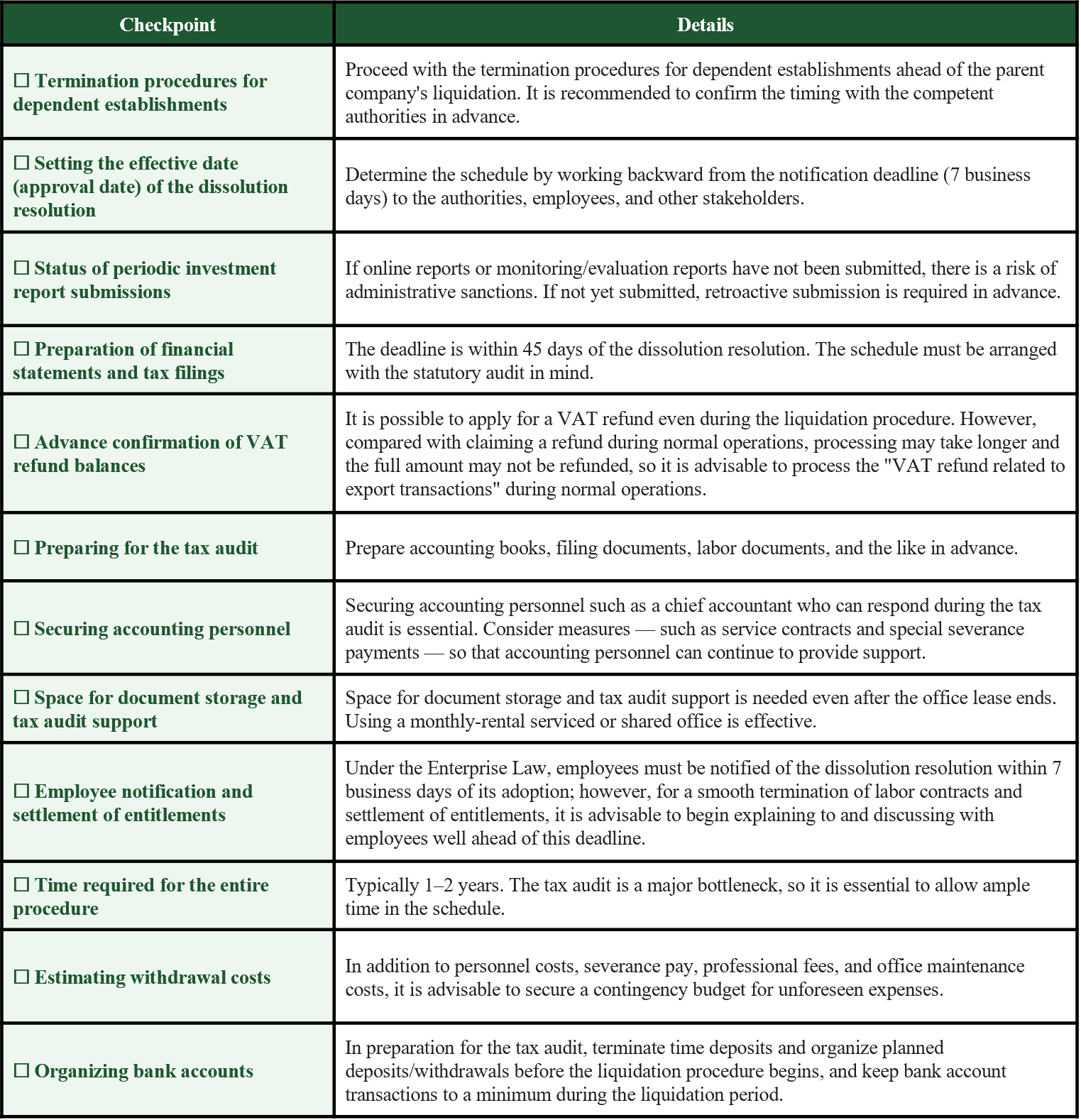
The points that management should keep in mind in advance are organized below in checklist form. Please review them against your company’s own circumstances.
Conclusion
When a company reviews its Vietnam operations, various options are conceivable, including downsizing, dormancy, and M&A/business succession. Even where liquidation is ultimately chosen as a result, liquidating an FDI company requires procedures across multiple fields — including tax, investment, and labor — and is expected to take a long time to complete. To carry out the liquidation procedure smoothly, it is important to understand the overall picture of the procedure and the required time and cost in advance, and to proceed with planned preparation before the liquidation decision is made.
Even if the expatriate returns home and local staff resign during the liquidation period, it may be possible to outsource the various procedures and responses to tax audits to an external consulting firm. Where it is difficult to handle matters in-house, it is advisable to consult a professional at an early stage as needed.
References
・ Enterprise Law (Law No. 59/2020/QH14 of 2020, as amended and supplemented by Law No. 76/2025/QH15 of 2025)
・ Investment Law (Law No. 143/2025/QH15 of 2025)
・ Labor Code (Law No. 45/2019/QH14 of 2019)
・ Law on Tax Administration (Law No. 108/2025/QH15 of 2025)
・ Decree 254/2026/ND-CP on invoices and documents
・ Social Insurance Law (Law No. 41/2024/QH15 of 2024)
・ Decree on Enterprise Registration (Decree No. 168/2025/ND-CP)
・ Decree on the Implementation of Investment Activities (Decree No. 96/2026/ND-CP)