
Key Considerations for FDI Enterprises
2026/05/20
- I-GLOCAL.CO.,LTD Hanoi Office
- CFE
- Kiriko Kashima
Executive Summary
①Machinery and equipment leasing is classified as an activity “directly related to the purchase and sale of goods” and is subject to conditional business regulations, requiring a business license valid for up to 5 years.
②Vietnam has not made WTO market-access commitments for this sector, meaning approval is subject to the competent authority’s discretionary judgment and may result in extended processing times.
③Investors from Japan (a WTO member) qualify under Case 1, allowing them to apply under more favorable international treaty conditions.
④Importation of machinery and equipment for leasing purposes is restricted to new equipment only; used/second-hand equipment cannot be imported for leasing.
⑤The business license must be renewed upon expiry (maximum validity: 5 years).
Introduction
The trend of expanding investment by foreign-invested enterprises (FIEs) in Vietnam’s manufacturing, processing, industrial, and construction sectors continues to accelerate, resulting in growing demand for machinery and equipment leasing. Under Vietnamese law, machinery and equipment leasing activities by FIEs — excluding the leasing of construction machinery and equipment with operators — are classified as activities ‘directly related to the purchase and sale of goods.’ As such, they are subject to market access conditions and require a business license under the relevant specialized legislation. Against this backdrop, this report explains the principal conditions and practical considerations that apply when FIEs conduct machinery and equipment leasing business in Vietnam (excluding the leasing of construction machinery and equipment with operators).
1. Principal Conditions Required to Conduct the Business
Machinery and equipment leasing refers to a business arrangement in which an enterprise allows another organization or individual to use its machinery or equipment for a specified period under a contract. This type of activity is widely utilized in the manufacturing, processing, industrial, and construction sectors. To lawfully conduct such activities, the following conditions must be satisfied.
1-1 Investment Conditions
Pursuant to Annex I of Decree No. 31/2021/ND-CP, machinery and equipment leasing is classified as a business sector subject to market access conditions for foreign investors. Whether such business is permitted in practice is determined based on Vietnam’s WTO commitments and other international commitments applicable to each category of leasing service.
Under Vietnam’s WTO commitments, machinery and equipment leasing services are a sector for which no market-opening commitments have been made to foreign investors. As a result, the law does not clearly specify whether a license will or will not be granted, and the outcome largely depends on the judgment of the competent authority at the time of application. After the investment registration application is submitted to the competent authority, the authority may issue a written consultation to the Ministry of Finance and other relevant sector-specific management ministries during the review process. When such consultation occurs, the process of seeking and receiving responses takes additional time, and the overall timeline for obtaining approval tends to be longer than usual.
1-2 Business Conditions
In addition to investment conditions, machinery and equipment leasing is classified as a conditional business activity directly related to the purchase and sale of goods under Decree No. 9/2018/ND-CP (hereinafter ‘Decree 9’). To lawfully conduct this business, in addition to registering the activity in the Investment Registration Certificate (IRC) and Enterprise Registration Certificate (ERC), the enterprise must obtain a business license from the competent authority, valid for a maximum period of 5 years.
Decree 9 classifies the conditions for issuing a business license as follows:
Case 1:Where the foreign investor is from a country or territory that is a party to an international treaty to which Vietnam is a member (including Japan), and a market-opening commitment exists for the purchase and sale of goods and directly related activities:
1. Satisfies the market access conditions stipulated in the international treaty to which Vietnam is a party (including the foreign investor’s equity ratio, form of investment, scope of investment activities, and the capacity of the investor and its investment partners);
2. Has a financial plan for conducting the business; and
3. If established in Vietnam for one year or more, has no outstanding tax obligations.
Case 2:Where the foreign investor is not from a country or territory that is a party to an international treaty to which Vietnam is a member:
1.Has a financial plan for conducting the business;
2.If established in Vietnam for one year or more, has no outstanding tax obligations; and
3.Satisfies the following assessment criteria:
・Compliance with relevant specialized legislation;
・Compatibility with the competitive landscape of domestic enterprises in the same sector;
・Potential for job creation for domestic workers; and
・Potential and degree of contribution to the state budget.
Note: A draft amendment to Decree 9 proposes more specific criteria for the employment creation requirement. This includes mandatory commitments to employ a minimum number of Vietnamese workers based on equity ratio — at least 100 Vietnamese workers where the equity ratio exceeds 50%, and at least 300 Vietnamese workers where the equity ratio is 100%.
Since investment from Japan falls under Case 1, applications for a business license may in principle be submitted within the framework of market access under international treaties. In practice, during the review of application documents, the competent authority also examines and assesses the scope of business activities to be registered, the specific business model, and the investor’s financial capacity and business experience. In contrast, applications under Case 2 are subject to additional scrutiny based on the assessment criteria — including competitiveness, employment creation, and contribution to the state budget — in addition to the common conditions. This means the processing period and the outcome of the license application may be significantly influenced by the discretionary judgment of the competent authority.
2.Basic Procedural Flow for FDI Enterprises to Conduct Machinery and Equipment Leasing Business
The basic procedural flow for FDI enterprises to lawfully conduct this business is divided into the following two cases.
Case 1:Where a Foreign Investor Newly Establishes an FIE to Conduct Machinery and Equipment Leasing Business
Where a foreign investor newly establishes an FIE, the procedures are carried out in the following sequence:

Case 2:Where an Existing FIE Adds a New Business Purpose or Investment Objective to Conduct Machinery and Equipment Leasing Business
Where an existing FIE adds machinery and equipment leasing as a new business activity, the procedures are carried out in the following sequence:
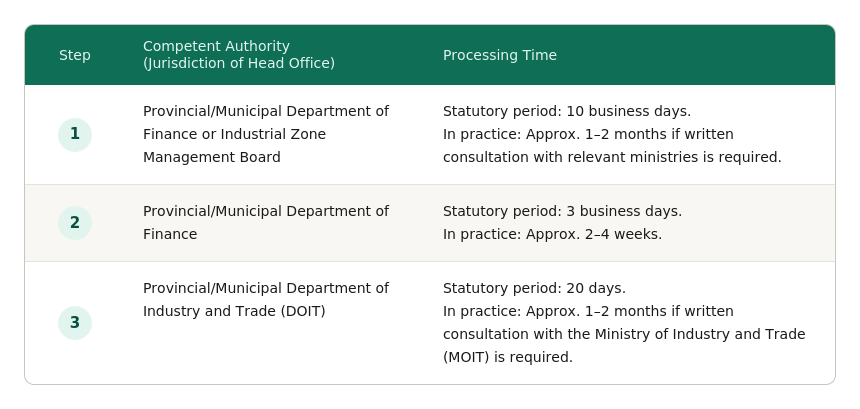
Competent Authorities and Processing Times at Each Step:
3. Key Considerations for FDI Enterprises Conducting Machinery and Equipment Leasing Business
Where an FIE imports machinery and equipment for the purpose of conducting a leasing business, only new machinery and equipment may be imported. Pursuant to Article 4, Clause 3 of Prime Ministerial Decision No. 18/2019/QD-TTg, used machinery, equipment, and production lines may only be imported when they are to be directly used in the enterprise’s production activities in Vietnam. Accordingly, the importation of used or second-hand machinery and equipment for leasing purposes is not permitted.
Conclusion
In practice, FIEs seeking to conduct machinery and equipment leasing business in Vietnam must examine both investment conditions and business conditions in tandem. Clarifying leasing demand in advance and confirming the competent authority’s licensing policy at the time of application is important in order to avoid the need for revisions during the application process and to prevent prolonged review periods. In addition, since the business license is valid for a maximum of five years, enterprises should also be aware that a renewal process will be required if they wish to continue operations after the license expires.
References
• WTO Commitments
• Decree No. 31/2021/ND-CP
• Decree No. 9/2018/ND-CP
• Prime Ministerial Decision No. 18/2019/QD-TTg
Related Reports
・Procedures for the Sale of Fixed Assets by Export Processing Enterprises
・Points to Note for Economic Demand Examination When Establishing Retail Stores (From the Second Store Onwards) in Vietnam