
Tax Considerations Related to Overtime Hours Exceeding Statutory Limits
2026/11/20
- I-GLOCAL.CO.,LTD. Hanoi Office
- Nguyen Thi Hue
Executive Summary
① The issue — Overtime is rising with business expansion, but exceeding the statutory limits is a violation even with both parties’ consent. Beyond administrative penalties, this creates tax risks for both corporate income tax (CIT) and personal income tax (PIT).
② Statutory limits — Overtime may not exceed 50% of standard daily hours on regular days or 12 hours on days off and holidays, 40 hours per month, or 200 hours per year. Certain sectors such as textiles, footwear and electronics may go up to 300 hours per year, but must notify the competent authority in writing within 15 days once overtime exceeds 200 hours.
③ CIT: expenses now explicitly non-deductible — Clause 23, Article 10 of Decree 320/2025/ND-CP (effective December 15, 2025) explicitly makes overtime expenses beyond the legal limits non-deductible. It applies from fiscal year 2025, and tax authorities may disallow daily, weekly or monthly overruns, not just the annual total. Missing the 200–300 hour notification also risks disallowance.
④ PIT: exemption lost for the excess — Under Clause 8, Article 4 of PIT Law No. 109/2025/QH15, only overtime wages paid within the legal limits are tax-exempt. If PIT was not withheld and declared on the excess portion, the enterprise may be required to pay the additional tax.
⑤ Recommended action — Enterprises organizing or planning overtime should assess the tax impact in advance and set up an internal process for the required notification.
Introduction
In enterprises operating in Vietnam, overtime work has been increasingly prevalent amid the expansion of production and business activities. This is a practical demand arising from both sides: for businesses, it offers the advantage of maintaining output while limiting the need to hire additional staff, while for employees, it provides an opportunity to increase their income. However, the 2019 Labor Code and related legal documents have set maximum overtime limits with the aim of protecting the long-term health and rights of employees. Therefore, even when arising from the voluntary agreement of both parties, exceeding these limits is still considered a violation of the law. When this occurs, businesses not only face the risk of administrative penalties, but may also encounter tax issues on two fronts: corporate income tax and personal income tax.
This article analyzes the tax risks arising from overtime expenses that exceed the limits prescribed by law.
1.Overview of Overtime Limits Under the Law
Overtime refers to working hours beyond the standard working hours stipulated in labor law, collective labor agreements, or internal labor regulations. Pursuant to Article 107 of the 2019 Labor Code and Decree 145/2020/ND-CP, in order to organize overtime work, enterprises must obtain the consent of employees and satisfy the conditions prescribed by law. The statutory overtime limits are specifically regulated as follows:
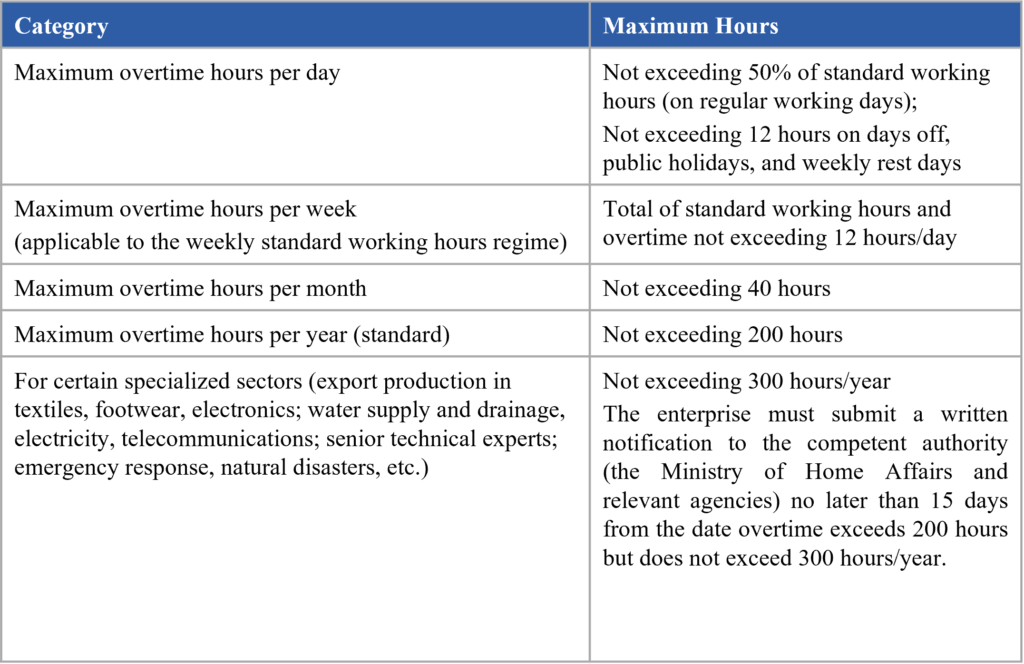
2. Corporate Income Tax Risks
Previously, the corporate income tax regulations did not clearly address overtime expenses that exceeded labor law limits. As a result, the tax authorities typically expressed their position through tax inspections, audits, or responses to enterprise inquiries that such expenses were not considered deductible, on the grounds that the related documentation did not satisfy the general condition for expense recognition — namely, the legality of the supporting documents under applicable law. To date, the current regulations have addressed this matter more explicitly than before. Specifically: Clause 23, Article 10 of Decree 320/2025/ND-CP (the Decree guiding the implementation of the Corporate Income Tax Law) effective from December 15, 2025 explicitly stipulates that overtime expenses exceeding the hours permitted under labor law are non-deductible expenses for corporate income tax purposes. This means that enterprises will be required to pay additional CIT on such amounts.
This Decree applies from the corporate income tax period for fiscal year 2025. As a result, going forward, tax authorities may pay closer attention to this category of expenses during enterprise inspections and audits — not only examining whether total annual overtime exceeds the threshold set by labor law, but also scrutinizing daily, weekly, or monthly overtime overruns as a basis for disallowing expenses. Enterprises should be particularly mindful of this point in order to proactively identify and manage potential corporate income tax risks.
In addition, where overtime is organized between 200 and 300 hours per year, enterprises are obligated to submit a written notification to the competent authority within 15 days from the date of implementation. This notification procedure is often overlooked in practice and has in many cases been submitted past the deadline. We therefore recommend that enterprises establish internal management processes in advance to ensure compliance. If the notification procedure is not carried out in accordance with the regulations, there is a risk that the related expenses may be deemed non-deductible for corporate income tax purposes.
3. Personal Income Tax Risks
Clause 8, Article 4 of the Personal Income Tax Law No. 109/2025/QH15 stipulates that overtime wages paid in accordance with the provisions of the law are tax-exempt income.
This means that the wages paid for overtime hours exceeding the limits prescribed by labor law carry the risk of not qualifying for the tax exemption. Therefore, if enterprises did not declare and pay personal income tax on such amounts, the tax authorities may determine that such income does not qualify for the exemption, and consequently require the enterprise to withhold additional personal income tax on the non-compliant overtime wages.
Conclusion
The analyses above reflect the tax risks that enterprises employing workers for overtime beyond the limits permitted under labor law may face, encompassing both CIT and PIT risks — disallowance of deductible expenses for corporate income tax purposes and the risk of additional PIT obligations arising.
For enterprises that are considering or currently organizing overtime for employees to meet business production requirements, it is essential to pay close attention to the issues discussed above in order to assess the impact and make appropriate decisions.
Early identification and management of these risks not only helps enterprises avoid tax arrears and administrative penalties, but also contributes to strengthening their overall legal compliance framework.
References
・Decree 320/2025/ND-CP dated December 15, 2025, guiding the implementation of the Corporate Income Tax Law
・Personal Income Tax Law No. 109/2025/QH15 dated December 10, 2025
Related reports
・Overview of Personal Income Tax in Vietnam