
Practical Issues Observed in the First-Year Global Minimum Tax (GMT) Filings ― Four First-Year Cases and How to Prepare from the Second Year Onward
2026/10/23
- I-GLOCAL.CO.,LTD. Hanoi Office
- U.S. CPA
- Katsuki Kumagai
Executive Summary
(1) Scope assessment – The EUR 750 million threshold is tested against consolidated total revenue, not net sales, and only the prescribed exchange rates may be used. A different testing period or a different rate can reverse the conclusion on whether the group is in scope.
(2) Safe Harbour test – In principle, the test is made using the figures in the Qualified CbCR of the ultimate parent entity. A provisional judgment based on figures prepared under Vietnamese Accounting Standards may lead to the wrong conclusion.
(3) Different fiscal year ends – Even where the Vietnamese entity and the ultimate parent entity have different fiscal year ends, no adjustment is required for the Safe Harbour test (though figures aligned with the UPE’s fiscal year may be needed for the full calculation where the UPE consolidates on the basis of its own fiscal year).
(4) More than one route to relief – Even where the Transitional Safe Harbour is not available, another route may be worth considering: the de minimis exclusion (the election to treat the QDMTT as zero), which is a permanent rule.
(5) Whether the CbCR is a Qualified CbCR – A Qualified CbCR, which is the basis of the Transitional Safe Harbour test, must be based on data from finalized financial statements. A CbCR prepared using draft figures does not meet this condition.
Introduction
Under the GMT rules, even for the same group and the same fiscal year, the choice of data can lead to an incorrect conclusion as to whether the rules apply. Does the figure that forms the starting point of the assessment come from the consolidated data of the ultimate parent entity (the “UPE”), or from the accounting figures of the Vietnamese entity? In practice, this difference decides the answer in many situations.
In Vietnam, the global minimum tax (“GMT”) was introduced by National Assembly Resolution No. 107/2023/QH15 (“Resolution 107”) and Decree No. 236/2025/ND-CP (“Decree 236”), and applies to fiscal years beginning on or after January 1, 2024. The first year of filings was largely completed during the first half of 2026. This article takes up four of the cases we supported that should be useful for filings from the second year onward. An outline of the rules, the filing procedures and the calculation of the top-up tax are explained in a separate article, to which readers are referred.
1.A Case Where Views Differed on Whether a GMT Filing Obligation Arose
1.1 Overview of the case
This is a case of a Japanese manufacturing group. The client’s own assessment was that “consolidated sales do not reach EUR 750 million, so the group is out of scope of the GMT,” but our assessment reached a different conclusion. The difference arose from two points: (i) which fiscal years are tested (the testing period), and (ii) which rate is used to convert Japanese yen into euro.
1-2 The rules applied
For the testing period, the four fiscal years immediately preceding the year being tested are reviewed. If consolidated total revenue is EUR 750 million or more in two or more of those years, the group is in scope. The total revenue of the year being tested itself is not used. The conversion rate is the average of the rates published by the European Central Bank (ECB) for December of the year preceding the year in which the fiscal year begins. Note also that the figure used is consolidated total revenue, including non-operating income and similar items, not net sales.
Figure 1 Testing period and conversion rates where the fiscal year ended March 2025 is tested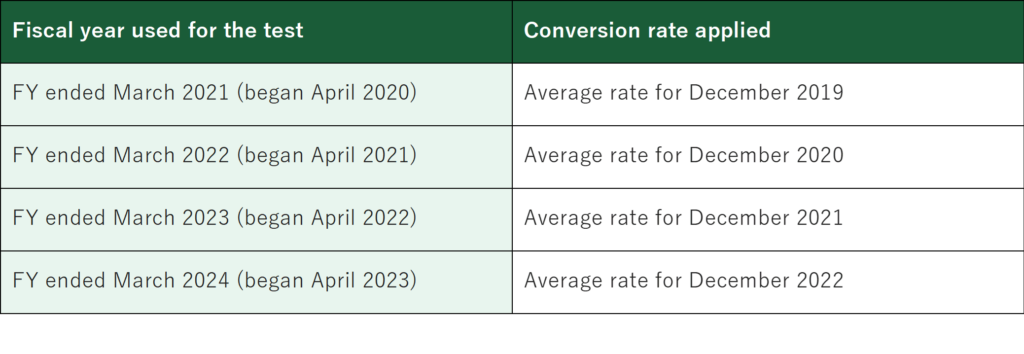 If consolidated total revenue is EUR 750 million or more in two or more of the four fiscal years above, the group is within the scope of the GMT.
1.3 Key points of this case
The EUR 750 million threshold has to be converted into Japanese yen. As the yen weakens, therefore, the threshold amount in yen rises year by year.
Figure 2 The EUR 750 million threshold converted into Japanese yen at different rates
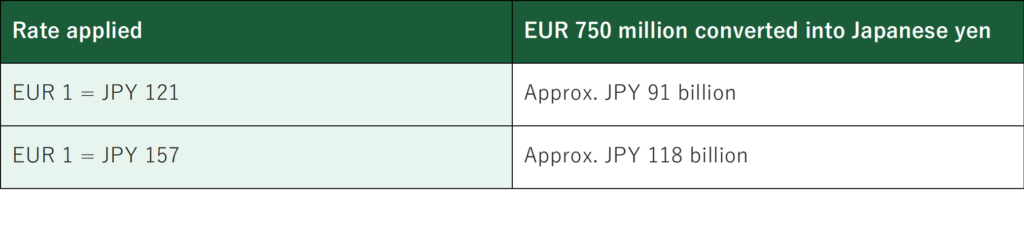
The gap is close to 30%. For a group with consolidated total revenue of around JPY 100 billion to JPY 140 billion, using the rate of the wrong year alone can reverse the conclusion on whether the group is in scope. In this case as well, when the calculation was redone using the correct testing period and exchange rates, the threshold was exceeded in two of the four preceding fiscal years, and we concluded that a GMT filing obligation arose.
In addition, a group may exceed the threshold in one particular year only, because of foreign exchange gains or a one-off extraordinary gain. A self-assessment based on sales alone therefore needs to be checked carefully.
2. A Case Where the Safe Harbour Conclusion Was Reversed by the Final Data
2.1 Overview of the case
This is a case of a manufacturer with several constituent entities (“CEs”) in Vietnam. As with many Japanese groups, the Japanese head office, which is the UPE, prepared its consolidated financial statements under Japanese GAAP in Japanese yen.
A trial calculation based on provisional data suggested that the Transitional Safe Harbour was likely to be available. After a detailed review using the final data, however, none of the four tests ((i) the de minimis test, (ii) the simplified ETR test, (iii) the routine profits test and (iv) the loss test) were met, and the conclusion was that top-up tax would arise.
2-2 Key points of this case
In principle, the Transitional Safe Harbour test is made using the figures in the UPE’s Qualified CbCR (for most Japanese groups, figures under Japanese GAAP or IFRS in Japanese yen). It should be noted that using figures prepared separately in Vietnam under Vietnamese Accounting Standards (VAS) in VND as they are may lead to the wrong conclusion.
A trial calculation at the provisional stage is useful for understanding the general direction. When sharing it internally or making decisions, however, it is advisable to allow for the possibility that the conclusion may change once the final data is available.
3. A Case Involving Different Fiscal Year Ends and the Permanent De Minimis Exclusion
3.1 Overview of the case
This is a case of a group in the service sector. The UPE has a September fiscal year end and had three CEs in Vietnam (two with a September year end and one with a December year end). Because the fiscal year ends differed among the CEs and from that of the UPE, data collection and calculation were initially expected to be complex.
A provisional assessment also indicated that the requirements of the Transitional Safe Harbour were not met and that top-up tax would arise. A closer review of the regulations then showed that the de minimis exclusion, which is a permanent rule, might be available (subject to verification using the UPE’s final data).
3-2 Treatment of different fiscal year ends
The treatment of a difference in fiscal year ends depends on the purpose for which the figures are used.
Figure 3 Whether an adjustment for different fiscal year ends is required, by situation
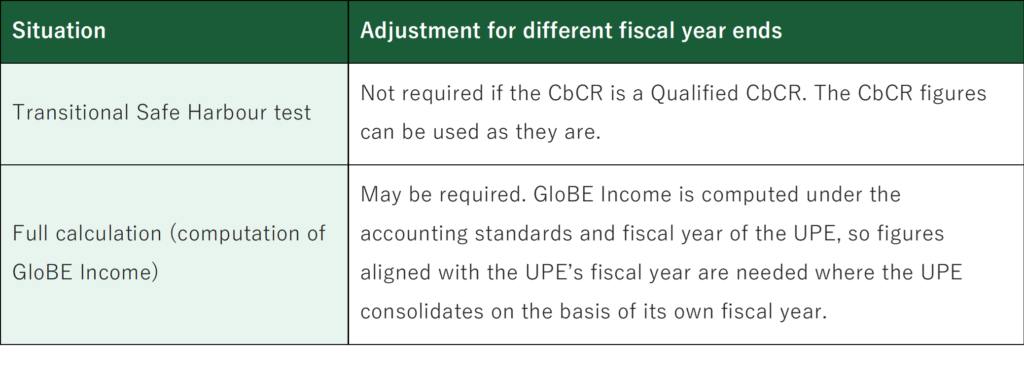
In this case, the CbCR and the consolidation package had already been adjusted to the fiscal year of the UPE, so no additional adjustment for the difference in year ends was required even for the CE with a December year end. The starting point is therefore to check whether the consolidated financial statements and the CbCR are prepared on the basis of the UPE’s fiscal year.
3.3 Outline of the permanent de minimis exclusion
Under Article 4.9 of Resolution 107, for a fiscal year in which both of the following conditions are met, the group may elect to treat the Qualified Domestic Minimum Top-up Tax (QDMTT) as zero (the election may be made each year).
– Average revenue in Vietnam under the GMT rules is less than EUR 10 million
– Average income is less than EUR 1 million, or there is a loss
※”Average” here means the three-year average of the current fiscal year and the two immediately preceding fiscal years (Article 3.14 of the same Resolution).
Where the zero election is made in Vietnam, the treatment at the parent company level has to be considered under the rules of the jurisdiction in which the UPE is located, and should be confirmed with a tax adviser in that jurisdiction.
4. A Case Where the “Qualified” Status of the CbCR Was at Issue
4.1 Overview of the case
This is a case of a manufacturing group. Differences in corporate income tax expense and in the deferred tax asset balance were identified among three data sources: (i) the audited financial statements, (ii) the CbCR and (iii) the amount payable per the corporate income tax return.
The group’s policy was to take the VAS audited financial statements of the Vietnamese CE into the CbCR. However, the corporate income tax amount in the reporting package submitted to the parent company for consolidation purposes was a draft figure. A difference arose when the corporate income tax return was finalized but, because the difference was small, the final figures were not re-reported to the parent company, and the CbCR was prepared without being updated.
4-2 Qualified CbCR and Qualified Financial Statements
Under Article 11.2 of Decree 236 and Section V of Appendix II, the four tests of the Transitional Safe Harbour (de minimis, simplified ETR, routine profits and losses) are made using the figures in a “Qualified CbCR.” A Qualified CbCR must be based on data from “Qualified Financial Statements,” and the acceptable data sources are any of the following.
– The accounting data of each CE used to prepare the UPE’s consolidated financial statements (the consolidation package)
– The separate financial statements of each CE (prepared under an Acceptable Financial Accounting Standard or an Authorised Financial Accounting Standard; VAS may also qualify)
– For CEs that are not material, the accounting data used to prepare the CbCR
Using VAS financial statements as the source data for the CbCR is therefore an acceptable route in itself, but the figures must be final. A CbCR prepared on the basis of provisional figures, as in this case, carries the risk of not being treated as a Qualified CbCR, in which case the application of the Safe Harbour may be denied on a tax audit.
5. Practical Steps for the Second Year and Beyond
For filings from the second year onward, it is useful to have the following three points in place in advance.
Checking the required documents
Organize the financial data used for consolidation, the CbCR, the corporate income tax return and the exchange rates applied into a checklist, and share it with the UPE. For the consolidation data in particular, it is often smoother to confirm matters directly with the Japanese head office rather than through the accounting staff in Vietnam.
Checking that the data is final
Confirm whether the CbCR has been prepared using final figures, reconcile it with the CE audit reports at an early stage, and understand the nature of any differences.
Agreeing how to proceed
Agree in advance on the overall timeline and the allocation of roles for the GMT procedures, and in particular on the scope of the work to be handled by the UPE.
Conclusion
What the first-year cases had in common was not a difficult interpretation of the rules, but the questions of where the figures used for the assessment come from and whether those figures are final. Deciding in advance where the necessary data will be obtained from, and by when, makes the process considerably smoother.
For filings from the second year onward, the workload depends on how far the work done in the first year can be reused. We recommend keeping a record of the reconciliation results and of the data sources used, and designating a contact point for coordination with the UPE. We provide support across the whole GMT process, from the scope assessment through to the filing, so please feel free to contact us if you need assistance.
This article is based on the regulations in force as at the date of the seminar held on July 31, 2026. Since then, a draft decree amending Decree 236 (dated July 28, 2026) and a draft resolution amending Resolution 107 (dated August 4, 2026) have been released. They include a one-year extension of the transition period, unification of the GIR filing deadline at 18 months, and abolition of the obligation to submit the report of the UPE’s consolidation package financial data. Both are still at the draft stage, and their contents may change before promulgation.
References
– National Assembly Resolution No. 107/2023/QH15
– Decree No. 236/2025/ND-CP
Related Reports
・What is global minimum taxation?
・Notification and filing procedures for global minimum tax
・Introduction of the Global Minimum Taxation System (GMT) in Vietnam