
Tax debt and the risk of exit suspension: important changes from 01/07/2026 that enterprises must know
2026/10/06
- I-GLOCAL.CO.,LTD Ho Chi Minh Office
- Director
- Pham Thanh Tam
Executive Summary
① Overview of the change — Effective July 1, 2026, the Law on Tax Administration No. 108/2025/QH15 and Decree No. 252/2026/ND-CP fundamentally change the rules on exit suspension for tax debt: the scope is extended to enterprises’ beneficial owners and foreign individuals, a 30-day advance warning is introduced, and the cancellation conditions are eased.
② Two new points with the greatest impact on FDI enterprises — (1) Beneficial owners are now subject to exit suspension, so risk extends beyond the named legal representative to individuals with actual ownership or control. (2) Foreign individuals face no monetary threshold—any single overdue unpaid tax amount, including PIT arising on finalization, is sufficient grounds.
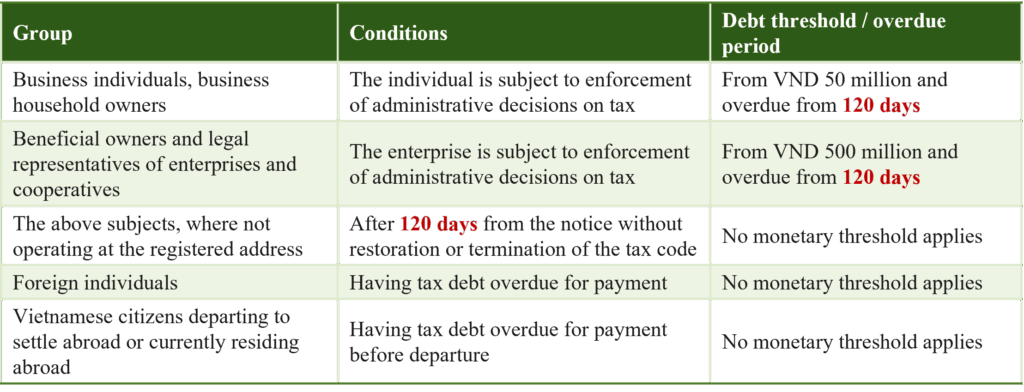
③ Five groups and thresholds — Business individuals (from VND 50 million, overdue 120+ days); beneficial owners/legal representatives of enterprises (from VND 500 million, overdue 120+ days); the above where not operating at the registered address; foreign individuals; and Vietnamese citizens settling abroad. The last three have no monetary threshold.
④ Procedure and eased cancellation — The first three groups receive a 30-day advance notice before enforcement (foreign individuals and those settling abroad are notified immediately). Whereas full payment was previously required, suspension is now lifted once the remaining debt falls below the threshold (VND 50 / 500 million). Where payment is made but not yet reflected, submitting a scanned receipt allows emergency cancellation.
⑤ Immediate actions for enterprises — Maintain electronic tax accounts and keep contact details current; assign a weekly checker; reconcile tax obligations quarterly (including branches); resolve tax codes in status 03/06; review debts and identify the beneficial owner before changing the legal representative; and finalize PIT for departing foreign staff before they leave. Status can be checked via eTax Mobile, thuedientu.gdt.gov.vn, and related portals.
Introduction
From 01/07/2026, the Law on Tax Administration No. 108/2025/QH15 and Decree No. 252/2026/ND-CP have fundamentally changed the regulation on suspension of exit due to tax debt: the scope of application for exit suspension measures has been extended to beneficial owners of enterprises and foreign individuals, at the same time adding a 30-day advance warning mechanism and easing the conditions for cancellation. Below are the key points that enterprises and managers need to understand.
Notable statistic: according to the Tax Department’s announcement on 21–22/05/2026, approximately 105,000 taxpayers have been issued exit suspension notices, with total debt of nearly VND 61,000 billion.
1. Who may be subject to exit suspension?
Article 28 of Decree 252/2026/ND-CP outlines 5 groups that are subject to exit suspension measures:
2.Application procedure: 30-day advance warning
For the first three groups, the tax authority would send a notice 30 days in advance through the electronic tax transaction account and publishes it on the Tax authority’s website. If the obligation remains unfulfilled after the deadline stated in the notice, the official notice is transferred to the immigration authority and implemented on the same day it is received.
Note: for foreign individuals and Vietnamese citizens departing to settle abroad, the notice is sent immediately, with no 30-day advance warning step.
Duration: for foreigners, no more than 03 years, with possible extension; for Vietnamese citizens, no maximum duration is fixed, ending when the obligation has been fully completed.
3.Key change: the debt need not be paid in full for the suspension to be lifted
Previously, for all 5 groups, the entire tax obligation had to be fulfilled before an exit suspension could be cancelled. Under Decree 252/2026/ND-CP:
- For the first two groups, cancellation takes place as soon as the remaining debt falls below VND 50 million or VND 500 million respectively.
- For the group not operating at the registered address, the tax code must also be restored or terminated.
- For foreign individuals and Vietnamese citizens residing abroad, the entire obligation must be fulfilled or the debt written off.
Regarding payment made but not yet updated in the system: the taxpayer submits a scanned copy of the payment document through the Tax Administration Information System; the tax authority issues a cancellation notice immediately upon receiving the response. This is the emergency solution where the flight date is imminent.
4.How to quickly check your tax obligations
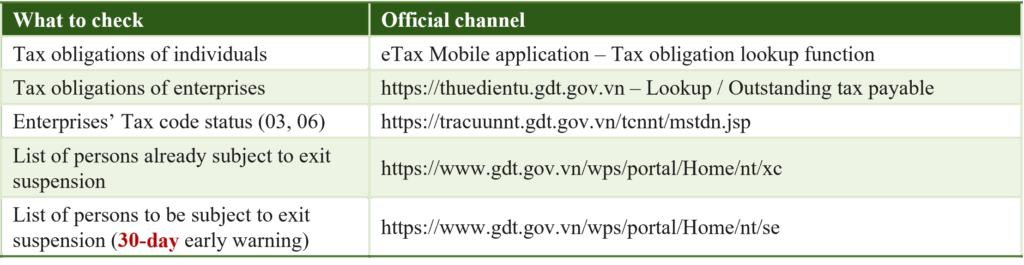 Lookup results reflect only the status at the time of the lookup and do not replace reconciliation with the directly managing tax authority.
5.Six actions enterprises should take now
- Maintain electronic tax transaction accounts for both the enterprise and the legal representative; keep email addresses and phone numbers up to date.
- Assign a person in charge to check the electronic tax account weekly, particularly in cases where the legal representative does not reside in Vietnam.
- Reconcile tax obligations quarterly, including those of branches and dependent business units.
- Fully resolve tax codes in status 03 or 06 of the enterprise and related units.
- Review outstanding tax liabilities before changing the legal representative; clearly identify the beneficial owner.
- For foreigners ending their assignment in Vietnam: finalize personal income tax and obtain confirmation that tax obligations have been completed before leaving Vietnam.
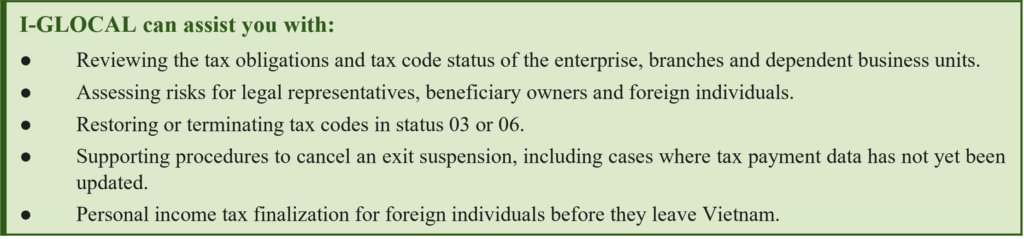 The above report is based on information available at the time of writing and is general in nature; it does not represent advice on any specific case. Please contact I-Glocal for advice suitable to your situation.
Related reports
・Latest Decree on measures to suspend departure from Vietnam due to unpaid taxes