
Some obligations of enterprises in cases of Employee work suspension
2026/11/19
- I-GLOCAL.CO.,LTD. Ho Chi Minh City Office
- Tran Thanh Phuong Thao
Executive Summary
① What work suspension is — The law has no specific definition, but under Article 99 of the Labor Code it can be understood as the employee temporarily not performing work while the labor relationship continues. Unlike suspension of labor contract execution, which applies only in statutory cases such as military service or detention and is generally unpaid, work suspension still entitles the employee to wages depending on the cause.
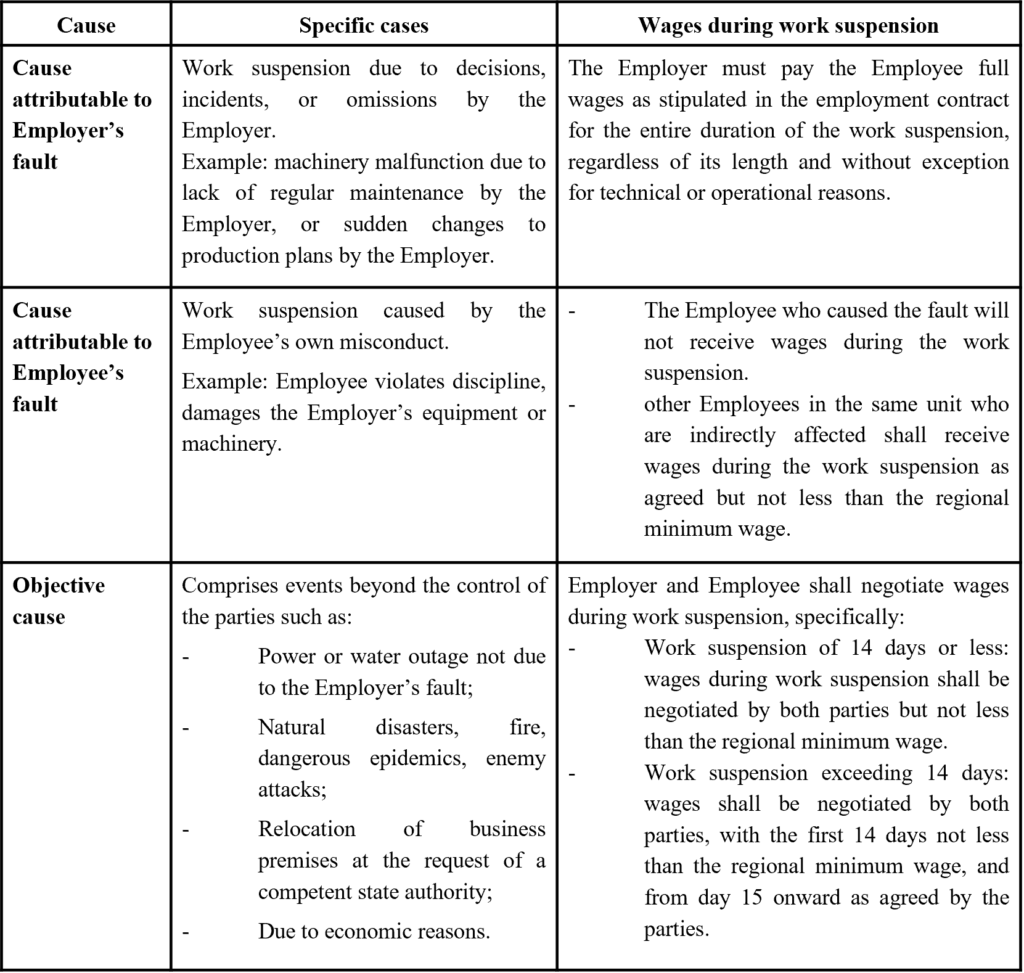
② Wages by cause — If the employer is at fault, full contractual wages are due for the entire period. If the employee is at fault, that employee receives no wages, while other indirectly affected employees in the same unit receive an agreed amount no lower than the regional minimum wage. For objective causes (power or water outages, natural disasters or epidemics, relocation ordered by the authorities, economic reasons), the first 14 days must be paid at no less than the regional minimum wage, and from day 15 as agreed.
③ Proving and recording the cause — The cause determines all of the employer’s obligations. Objective causes offer the most flexibility, but without evidence such as utility notices, official decisions, relocation orders or financial statements, the suspension may be deemed the employer’s fault. Relocations decided internally and the company’s own economic difficulties call for particular caution.
④ Duration, wages and insurance — There is no legal maximum duration, but the start and expected end dates, and any agreed wage, should be recorded in writing. SI, HI and UI contributions continue based on the wages received during the suspension, but no SI contribution is required for a month in which the employee receives no wages for 14 or more working days, unless agreed otherwise.
⑤ Obligations afterwards — Employees must be returned to work under their contract and cannot be dismissed except as permitted by law. The suspension period counts toward the contract term, so employers should consider a new contract when a fixed-term contract is nearing expiry.
Introduction
In the practical operations of enterprises, cases of employee work suspension are quite common. The Labor Code 2019 (“Labor Code”) has established specific obligations for employers (“Employers”) in such cases. This report aims to provide an overview of the key obligations of Employers as well as the legal risks arising from work suspension, thereby assisting enterprises in proactively identifying and handling such situations in compliance with the law.
1.Concept of work suspension
Current labor law does not provide a specific definition of work suspension. However, based on Article 99 of the Labor Code and related provisions, work suspension can be understood as the Employee temporarily not performing work under the labor contract for a certain period of time, while the labor relationship between the parties still exists.
Employers must distinguish “work suspension” from “suspension of labor contract execution”. Both are states where the Employee temporarily does not perform work under the labor contract, but their nature and legal consequences are different.
“Suspension of labor contract execution” only applies in cases specified by law, such as fulfilling military obligations, temporary detention, pre-trial detention, etc., and the Employee is not entitled to wages during this period unless otherwise agreed.
Meanwhile, “work suspension” arises due to the fault of one party, the Employer’s operational needs, or objective events, and the Employee is still entitled to wages at a certain level depending on the cause.
2. Cases of work suspension and wages during work suspension
The Labor Code classifies cases of work suspension based on the cause and corresponding wages as follows:
3. Notes for Employers in cases of work suspension
3-1 Duration of work suspension
The law does not prescribe a maximum limit for the duration of work suspension; this is determined by the Employer and Employee, but must be consistent with the reason for the work suspension. Employers should record in writing the start date and expected end date of the work suspension as a basis for calculating wages, determining when obligations arise, and protecting the enterprise in the event of a dispute.
3-2 Proving and retaining records on the cause of work suspension
The cause of work suspension is the basis for determining all of the Employer’s obligations. Therefore, Employers must clearly identify the cause from the outset and retain appropriate evidentiary documentation, as follows:
Firstly, cause attributable to the Employer’s fault: Documents relating to the notice of work suspension issued to Employees, clearly stating the reason and expected duration of the work suspension.
Secondly, cause attributable to the Employee’s fault: Records of violations, disciplinary decisions, and documents clearly identifying the Employee’s fault and the scope of directly affected Employees, as a basis for applying the appropriate wage payment regime to each group.
Thirdly, objective cause: This group of causes provides the most flexible mechanism for Employers, however, it requires rigorous supporting documentation to avoid being considered a work suspension due to Employer fault.
①If due to a power or water outage not due to the Employer’s fault: power/water outage incident report accompanied by a notice of supply interruption from the power/water utility (if available);
②If due to natural disasters, fire, dangerous epidemics, enemy attacks: decisions or notices from competent state authorities declaring natural disasters or epidemics, or records of fire or enemy attack incidents confirmed by local authorities;
③If due to relocation of business premises at the request of a competent state authority: official relocation request from the state authority. For cases where the Employer independently decides to relocate for internal reasons without a state authority’s written request, the resulting work suspension carries the risk of being deemed the Employer’s fault;
④If due to economic reasons:
a. For cases arising from a general economic crisis, recession, or restructuring pursuant to state policy, Employers must retain official documents and notices from competent state authorities regarding the crisis/recession or related restructuring policies.
b. For cases arising from the enterprise’s own internal economic difficulties, Employers must retain specific supporting financial documents, such as financial statements reflecting a decline in profits. However, as current law has not yet provided specific guidance on this case, Employers must exercise caution in its application to avoid the risk of being considered a work suspension attributable to the Employer’s fault.
3-3 Payment of wages during work suspension
Employers must correctly identify the cause of work suspension in order to apply the appropriate wage level for each group as analyzed in Section 2. For cases requiring wage negotiation, Employers must retain written records of the agreed wage as a basis for resolution in the event of a dispute.
3-4 Social insurance (“SI”), health insurance (“HI”) and unemployment insurance (“UI”) during work suspension
During the work suspension period, the employment contract remains in effect, so Employers are still obligated to continue contributing to SI, HI, and UI on behalf of Employees based on the wages received by the Employees during the work suspension period. However, in cases where an Employee does not receive wages for 14 or more working days in a month, SI contributions are not required for that month, unless the parties agree otherwise.
3-5 Obligations after the work suspension period
After the work suspension period, Employers are obligated to arrange for Employees to return to work under the signed employment contract and may not terminate the employment contract except in cases permitted by law. Additionally, the duration of the work suspension is still counted toward the term of the employment contract. Therefore, if the employment contract term is approaching its expiration date, Employers should proactively consider signing a new employment contract if they wish to continue employing the Employee.
Conclusion
In summary, when a work suspension occurs, Employers must correctly identify the cause, as this is the basis for fulfilling all related obligations. Full compliance with legal regulations not only helps enterprises protect the rights and interests of Employees, but also minimizes legal risks and disputes that may arise in practice.
Reference Documents
・Labor Code 2019
・Law on Social Insurance 2024
Related reports
・Approaches to Wage Adjustment in Enterprises and Related Points to Note