
Guide to Consular Legalization Procedures in Japan―Authentication and Notarization Procedures for Using Foreign Documents in Vietnam
2026/04/29
- I-GLOCAL.CO.,LTD Hanoi Office
- CFE
- Kiriko Kashima
Executive Summary
As Vietnam is not a party to the Hague Convention, consular legalization by the Vietnamese Embassy or Consulate is, in principle, required for Japanese documents to be used in Vietnam.
Key Points
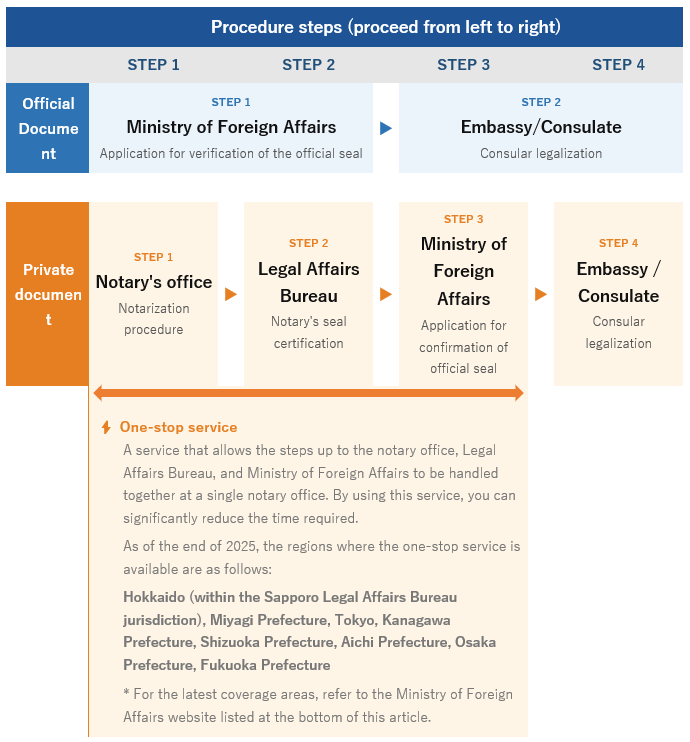
・[Document Classification] Procedures differ between public documents (issued by government authorities: 2 steps — Ministry of Foreign Affairs → Embassy) and private documents (issued by companies or individuals: 4 steps — Notary’s office → Legal Affairs Bureau → Ministry of Foreign Affairs → Embassy).
・[One-Stop Service] For private documents, the one-stop service at the notary’s office handles the Legal Affairs Bureau and Ministry of Foreign Affairs steps simultaneously, significantly reducing processing time. Available in: Hokkaido, Miyagi, Tokyo, Kanagawa, Shizuoka, Aichi, Osaka, and Fukuoka.
・[Converting Public to Private Documents] Attaching a declaration converts a public document into a private document, enabling use of the one-stop service and completion in as little as one day.
・[Fees & Processing Times] Ministry of Foreign Affairs: Free / approx. 4 business days. Notary’s office: JPY 3,500 (Japanese) / JPY 9,500 (foreign language) / approx. 1 hour. Embassy legalization: JPY 4,500 per document / in-person half a day / mail approx. 1 week.
・[Document Preparation Cautions] Dates on declarations and powers of attorney must be on or after the original document’s issuance date. Never remove staples, open sealed envelopes, or use highlighters — doing so invalidates the document.
1. What is consular legalization?
This refers to the legalization procedure performed to make public documents issued by Japanese government offices or private documents created by companies or individuals usable within Vietnam after undergoing prescribed procedures such as notarization.
Because Vietnam is not a party to the Hague Convention (Abolishing the Requirement of Legalisation for Foreign Public Documents), documents issued in Japan must be legalized by the Vietnamese Embassy or Consulate when submitted to Vietnamese government agencies or companies.
Foreign-issued documents that do not bear such consular legalization are, in principle, not accepted for various procedures by Vietnamese authorities.
Some documents may be eligible for consular legalization either in Japan or in Vietnam, but this guide explains only the consular legalization procedures in Japan.
Main usage scenarios
Consular legalization for Japanese documents is required in cases such as the following:
・Employment in Vietnam / application for a work permit
・Procedures for establishing a Vietnamese corporation
・Procedures for capital increase of a Vietnamese corporation
・M&A procedures related to investment in Vietnam
* It is advisable to check the laws and confirm in advance with the Vietnamese authority to which the documents will be submitted about which specific documents require authentication.
2. Differences between public documents and private documents
Because the authentication procedures differ depending on the type of document, it is important to first confirm whether the document to be submitted is a “public document” or a “private document.” The differences and main examples for each are as follows.
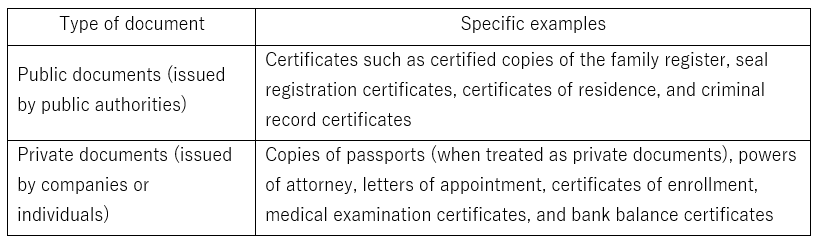
* Whether a university graduation certificate is treated as a public document or a private document varies by region in the interpretation of Vietnamese authorities, so it is advisable to confirm in advance before performing consular authentication.
3. Procedure flow and required documents
3.1 Procedure Flow
3.2 Required documents and fees for each step
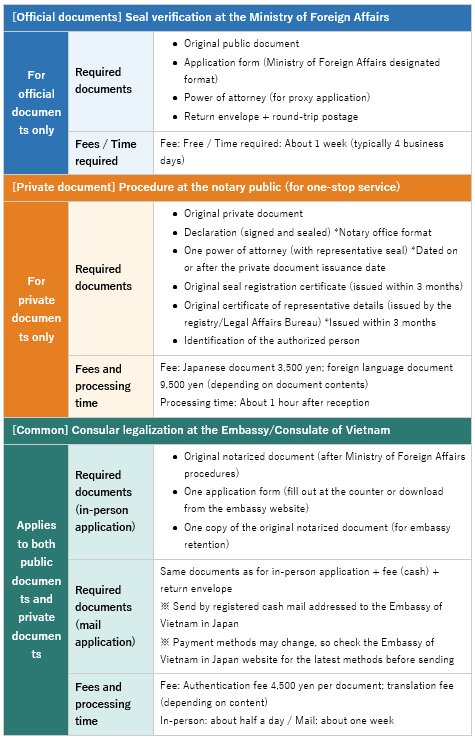
Some documents may require, in addition to consular legalization, translation into Vietnamese and authentication of the translated text. There are mainly the following two methods for handling this translation and authentication.
(1) Receiving translation authentication at the Vietnamese embassy or consulate in Japan;
(2) Bringing documents that have completed consular legalization in Japan to Vietnam, having them translated into Vietnamese within Vietnam, and then undergoing notarization.
If I-GLOCAL provides support, we will often implement it using method (2).
4. Frequently Asked Questions
Q: What does it mean to convert a public document into a private document? What are the benefits?
A: Documents issued by public authorities such as the Legal Affairs Bureau, like certified copies of the register, are public documents, so, in principle, the procedure should be through the Ministry of Foreign Affairs → the embassy. However, because Ministry of Foreign Affairs authentication is not done on the same day, documents must be collected again on the following day or later, which requires time and effort. By attaching the declaration and converting the public document into a private document through notarization at the notary office (in the case of the one-stop service) → proceeding with embassy procedures, all document procedures can be completed using the same steps and in as little as one day.
※Since the Ministry of Foreign Affairs certification does not incur a fee, when converting a public document into a private document and conducting notarization, the notary office fee will be charged just like for private documents.
Q: What are the procedures at the Vietnamese Embassy?
A: The Vietnamese Embassy (in Tokyo) is often crowded both in the morning and afternoon, so it is recommended to allow plenty of time when going for procedures. There are staff at the counter who can speak Japanese, so application procedures can be carried out in Japanese without particular problems. The embassy’s website lists a phone number, but be aware that they often do not accept inquiries by phone.
Q: What are examples of mistakes when preparing documents?
A1: For the document preparation sequence, the order is original document ⇒ declaration ⇒ power of attorney, so take care to set the dates on the declaration and power of attorney to dates on or after the issuance or acquisition date of the notarized original document. If the date on the declaration is earlier than the issuance of the original, it will be considered inconsistent with the contents and rendered invalid. If you are unsure, leaving them blank and filling them in before the notary during the notarization procedure is the safest option.
A2: For public documents issued by Japanese government agencies, the documents must be kept intact before applying for consular legalization at STEP 3 of the above flow. Be careful not to remove staples from originals, open the envelope of a certificate of no criminal record, or mark with a highlighter. If the integrity of a document is compromised, that document will become invalid and may need to be reissued.
Reference information
Ministry of Foreign Affairs
・Official seal procedures: https://www.mofa.go.jp/mofaj/toko/page22_000548.html
・One-stop service: https://www.mofa.go.jp/mofaj/toko/page22_000607.html
Embassy and Consulates of Vietnam in Japan
(Tokyo) Embassy of Vietnam in Japan: https://vnembassy-jp.org/ja
Address: 50-11 Motoyoyogi-cho, Shibuya-ku, Tokyo 151-0062, Japan
(Osaka) Consulate General of Vietnam in Osaka: https://vnconsulate-osaka.org/ja/
Address: 4-2-15 Ichinomachi-higashi, Sakai-ku, Sakai-shi, Osaka 590-0952, Japan
(Fukuoka) Consulate General of Vietnam in Fukuoka: https://vnconsulate-fukuoka.org/ja/
Address: 4th floor, Aqua Hakata, 5-3-8 Nakasu, Hakata-ku, Fukuoka-shi, Fukuoka 810-0801, Japan
Related information
・Amendments to Decree 219/2025/ND-CP Concerning the Procedures for Issuing Work Permits to Foreign Workers